
Nigeria’s dynamic economy presents a fertile ground for entrepreneurs ready to innovate and build. Yet, navigating this landscape to find genuinely profitable ventures requires more than just a good idea; it demands a clear understanding of the market’s needs, realistic startup costs, and a practical roadmap for execution. The challenge for many aspiring business owners is cutting through the clutter to identify which sectors offer the most substantial returns on investment and sustainable growth potential. This is where strategic insight becomes your most valuable asset.
This guide is designed to provide that clarity. We move beyond generic lists to offer a comprehensive blueprint for launching some of the best lucrative business in Nigeria. Instead of just presenting concepts, we will break down each opportunity with actionable steps, potential profit margins, and specific success strategies tailored to the Nigerian context. We will explore ten high-growth sectors, from AgriTech and Logistics to FinTech and Renewable Energy, giving you the detailed information needed to make an informed decision.
Think of this article not as a simple compilation of ideas, but as a practical manual for your entrepreneurial journey. You will learn about the capital required, the regulatory hurdles to anticipate, and the market gaps you can exploit. Our goal is to equip you with the knowledge to transform a promising concept into a thriving enterprise. Whether you are a seasoned investor or a first-time founder, the insights here will help you pinpoint the venture that aligns with your capital, skills, and ambition for building a successful business in 2025 and beyond. Let’s dive into the ventures that are currently shaping Nigeria’s economic future.
1. Logistics and Delivery Services
The explosion of e-commerce in Nigeria, spearheaded by giants like Jumia and Konga, has permanently altered the retail landscape. This digital shift has created a massive, non-negotiable demand for efficient logistics, making it one of the best lucrative business opportunities in Nigeria today. This business involves managing the movement of goods from a supplier to the end consumer, a critical process known as last-mile delivery.
Success in this competitive sector is built on a foundation of reliability, speed, and technology. As more Nigerians embrace online shopping for everything from fashion to electronics, their expectation for quick and traceable delivery has skyrocketed. Businesses that can meet this demand by providing dependable services, transparent tracking, and excellent customer support are positioned for significant growth. The need for these services extends beyond major cities like Lagos and Abuja into semi-urban and rural areas, opening up diverse market segments.
Why It’s Profitable
Logistics is the backbone of modern commerce. Without a functional delivery network, e-commerce platforms cannot operate, and traditional businesses struggle to expand their reach. This essential role ensures a consistent stream of demand. Furthermore, you can start small, perhaps with a single delivery bike in a specific neighbourhood, and scale up as your client base grows. This scalability, combined with high demand, makes it an attractive venture for aspiring entrepreneurs. For those looking to manage the administrative side of this business, there are even remote opportunities; you can explore related data entry roles from home that support logistics operations.
How to Get Started: A Step-by-Step Guide
- Define Your Niche & Location: Don’t try to serve all of Nigeria at once. Start hyper-local. Practical Example: Focus solely on delivering for Instagram fashion vendors within the Lekki-Ajah axis of Lagos. This allows you to master a specific route and build a reputation for speed and reliability in a concentrated area.
- Acquire and Insure Your Assets: Your budget determines your start. This could be one motorcycle (okada) or a small van. Ensure it is commercially registered and has Goods-in-Transit insurance to cover client packages against damage or loss.
- Leverage Technology for Efficiency: Use a basic logistics management app like Gokoada’s G-Send or an affordable subscription-based software to manage orders, provide real-time tracking links to customers, and optimise delivery routes.
- Onboard Your First Clients: Create a simple pricing flyer and a business WhatsApp account. Approach 10-20 online vendors in your chosen niche with an introductory offer (e.g., “Your first 5 deliveries at a 20% discount”). This helps you build a client base and gather crucial testimonials.
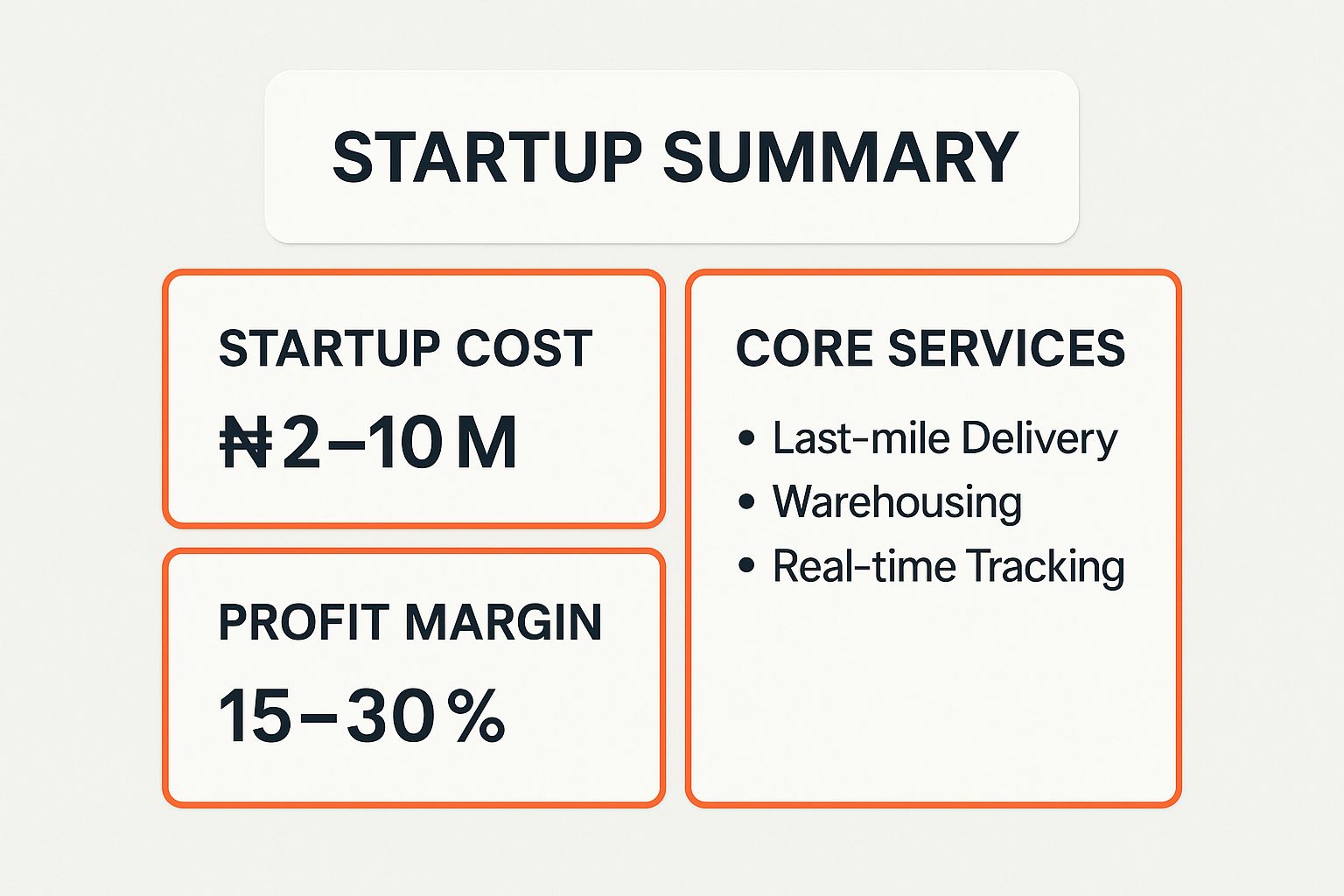
alt text: Infographic summarizing key metrics for a Nigerian logistics business, highlighting startup costs from ₦2–10 million, profit margins between 15–30%, and key services like last-mile delivery and real-time tracking.
Actionable Takeaways
- Start with a small, defined geographical area to master operations.
- Get Goods-in-Transit insurance immediately to build trust and protect your business.
- Use introductory discounts to attract your first 10 clients quickly.
Tools & Resources
- Logistics Software: G-Send by Gokoada, Sendstack.
- Further Reading: How to Start an Online Business.
2. AgriTech and Modern Farming
Nigeria’s vast arable land and growing population create a fundamental, ever-present demand for food, making agriculture a perpetually relevant sector. However, the real opportunity lies in shifting from traditional methods to modern, technology-driven farming. AgriTech involves integrating technology into every stage of the agricultural value chain, from planting and irrigation to harvesting and distribution, positioning it as one of the best lucrative business opportunities in Nigeria.

alt text: A modern farm in Nigeria with rows of healthy green crops, illustrating the integration of technology in agriculture.
Success in this field is driven by efficiency, sustainability, and market access. Innovators like Thrive Agric and Farmcrowdy have demonstrated the power of connecting investors with farmers and using data to optimise crop yields. As the nation pushes for food security and economic diversification, businesses that can improve farm productivity, reduce post-harvest losses, and create efficient supply chains are set for exponential growth.
Why It’s Profitable
Food is a basic human need, ensuring constant demand. AgriTech enhances profitability by increasing yields and reducing waste through precision farming. Technology helps overcome traditional obstacles like unpredictable weather and pests. This sector also attracts significant government support and private investment. The potential for high returns, combined with its critical role in the economy, makes modern farming a highly attractive venture.
How to Get Started: A Step-by-Step Guide
- Choose a High-Demand Niche: Focus on a specific product with a ready market. Practical Example: Start a hydroponics farm for lettuce and other leafy greens in a city like Port Harcourt. Urban restaurants and supermarkets constantly need fresh produce and are willing to pay a premium for a consistent supply.
- Acquire Knowledge and Land: Attend a workshop on hydroponics farming. Secure a small space (even a backyard or rooftop) for your initial setup. You don’t need a large plot of land to begin.
- Invest in a Starter Kit: Purchase a small-scale hydroponics system, quality seeds, and nutrient solutions. This initial investment is significantly lower than traditional farming equipment.
- Secure Off-takers Before You Plant: Approach 5-10 local restaurant managers and grocery store owners with samples. Sign a preliminary supply agreement with at least two of them. This guarantees a market for your produce and minimizes risk.
Actionable Takeaways
- Focus on a high-value urban farming niche like hydroponics to start small.
- Secure buyers (off-takers) before you make a significant investment in equipment.
- Start with a small-scale system to learn the process before expanding.
Tools & Resources
- Learning Platforms: National Agricultural Extension and Research Liaison Services (NAERLS).
- Further Reading: Empowering Nigeria’s Economic Growth: How Generative AI Solutions Can Transform Industries
3. Real Estate Development and Investment
Nigeria’s rapid urbanisation and growing population create a relentless demand for housing and commercial spaces, positioning real estate as a cornerstone of the nation’s economy. This sector involves everything from developing properties from the ground up to investing in existing ones for rental income or appreciation. It is undeniably one of the best lucrative business opportunities in Nigeria, offering a tangible asset that often appreciates faster than inflation.
Success in real estate is built on strategic location selection, due diligence, and an understanding of market dynamics. As cities like Lagos, Abuja, and Port Harcourt expand, the need for residential estates, office complexes, and retail centres grows exponentially. Investors who can identify and acquire properties in emerging high-growth corridors are set for substantial returns.
Why It’s Profitable
Real estate is a powerful wealth-creation tool because property is a finite resource with ever-increasing demand. It provides both cash flow through rental income and long-term capital appreciation. The barrier to entry can be high, but various strategies like joint ventures make it accessible. Furthermore, financing options are becoming more available. For an in-depth understanding of financing, prospective investors can explore an ultimate guide to DSCR loans for real estate investors. This makes it a viable venture for those with the right strategy.
How to Get Started: A Step-by-Step Guide
- Choose an Accessible Niche: You don’t need billions to start. Practical Example: Focus on “land flipping.” Buy a plot of land in a rapidly developing satellite town like Epe in Lagos or Idu in Abuja for ₦2-5 million. Hold it for 12-24 months as infrastructure develops, and then sell it for a 50-100% profit.
- Conduct Rigorous Due Diligence: This is the most critical step. Hire a reputable property lawyer to verify the land title (e.g., Certificate of Occupancy, Governor’s Consent) at the state’s Land Registry. Physically inspect the land and confirm its coordinates with a surveyor to avoid scams.
- Start Small or Pool Funds: If you can’t afford a full plot, partner with 2-3 trusted friends or family members to co-invest. Create a clear legal agreement outlining ownership percentages, exit strategies, and profit-sharing.
- Build a Professional Network: Connect with reliable real estate agents who specialize in your target area, surveyors, and property lawyers. This team is essential for finding genuine deals and navigating the legal complexities of transactions.
Actionable Takeaways
- Start with land flipping in developing areas; it requires less capital than construction.
- Never skip due diligence; always hire a lawyer to verify land titles at the official registry.
- Consider co-investing with a small group under a clear legal agreement to lower the entry barrier.
Tools & Resources
- Property Listings: Nigeria Property Centre, Private Property Nigeria.
- Further Reading: Ultimate guide to DSCR loans for real estate investors.
4. FinTech and Digital Financial Services
The Nigerian financial landscape is undergoing a dramatic transformation, driven by technology and a massive, youthful population eager for better banking solutions. This shift has catapulted FinTech into the spotlight, making it arguably the most lucrative business in Nigeria for tech-savvy entrepreneurs. This sector involves leveraging technology to deliver financial services, from mobile payments and digital lending to investment platforms and insure-tech.

alt text: A user holds a smartphone displaying financial icons, symbolizing the ease of FinTech transactions in Nigeria.
Success stories like Paystack and Flutterwave prove the immense potential. These companies thrive by addressing critical pain points: simplifying online payments for merchants, offering accessible savings options like PiggyVest, or providing quick loans. With a significant portion of Nigeria’s population still unbanked or underbanked, the opportunity for financial inclusion remains vast.
Why It’s Profitable
FinTech solves fundamental problems at scale. By digitising financial services, companies drastically reduce operational costs compared to brick-and-mortar banks. The model is highly scalable; once the technology is built, user acquisition can grow exponentially. The demand for seamless digital transactions, credit, and investment tools is ever-growing, ensuring continuous revenue from transaction fees, subscriptions, or interest. This technological wave is reshaping the nation’s economy, as Nigeria embraces emerging tech trends to solve local challenges.
How to Get Started: A Step-by-Step Guide
- Solve a Hyper-Specific Problem: Don’t try to build the next super app. Practical Example: Create a niche service that simplifies group savings (“ajo” or “esusu”) for market women. Develop a simple USSD-based platform that allows them to contribute daily and track their collection turn, addressing their specific trust and accessibility issues.
- Prioritize Regulation from Day One: The financial sector is heavily regulated by the Central Bank of Nigeria (CBN). Before writing a single line of code, consult with a lawyer specializing in FinTech to understand the licensing requirements for your specific service (e.g., Payment Solution Service Provider – PSSP).
- Develop a Secure Minimum Viable Product (MVP): Build a basic version of your product with a primary focus on security and simplicity. A user-friendly interface is crucial for building trust.
- Partner for Growth: You don’t have to build everything from scratch. Collaborate with a microfinance bank to hold funds or partner with a mobile money operator to facilitate transactions. This provides infrastructure and credibility, accelerating your path to market.
Actionable Takeaways
- Focus on solving one small, specific financial problem for a defined user group.
- Consult with a FinTech lawyer about CBN licensing before you start building.
- Partner with existing financial institutions instead of trying to build all infrastructure yourself.
Tools & Resources
- API Providers: Paystack, Flutterwave, Mono (for data).
- Further Reading: Nigeria Embraces RichlyAI Tech Trends.
5. EdTech and Online Education
The convergence of technology and education has created a burgeoning EdTech sector in Nigeria, driven by a massive youth population and a strong demand for skills that align with the digital economy. This industry involves creating and delivering educational content and solutions through technology, from mobile learning apps to online certification programmes. It represents one of the best lucrative business opportunities in Nigeria by addressing critical gaps in the traditional education system.
Success in this field hinges on relevance, accessibility, and measurable outcomes. Platforms like uLesson and PrepClass have demonstrated the high demand for supplementary learning tools tailored to the local curriculum. As more individuals and corporations recognise the need for continuous upskilling, businesses that provide certifications in high-demand areas like software development, data science, and digital marketing are poised for exceptional growth.
Why It’s Profitable
Nigeria’s demographic dividend, with over 60% of its population under 25, creates a vast market for educational services. The traditional educational infrastructure is often overstretched, leaving a gap that technology can fill efficiently. EdTech businesses benefit from high scalability; a single course can be sold to thousands of students with minimal incremental costs. For those interested in the foundational aspects of building such a venture, you can learn more about how to start an online business here.
How to Get Started: A Step-by-Step Guide
- Identify a Specific Skill Gap: Don’t try to teach everything. Practical Example: Create an online course focused on teaching small business owners how to use Canva and basic social media tools to market their products effectively. This is a specific, high-demand skill with a clear audience.
- Develop High-Value, Practical Content: Partner with an experienced digital marketer to create a 10-module video course. Ensure the content is project-based, allowing students to create a portfolio of actual marketing materials for their business as they learn.
- Choose a Simple Delivery Platform: You don’t need a custom website initially. Host your course on a platform like Selar or Tizeti, which handles payment processing and content delivery, allowing you to focus on marketing.
- Build a Community and Credibility: Create a free WhatsApp or Telegram group for potential students. Share valuable tips and case studies for a few weeks to build trust and authority before launching your paid course. Offer a certificate of completion to add value.
Actionable Takeaways
- Focus your first course on a single, practical skill that helps people make money.
- Use existing platforms like Selar to launch quickly without high development costs.
- Build a community and provide free value before asking for a sale.
Tools & Resources
- Course Platforms: Selar, Tizeti, Udemy.
- AI for Content: AI Lesson Plan Generators can help structure your curriculum.
- Further Reading: How to Start an Online Business.
6. Healthcare Services and Medical Tourism
Nigeria’s vast population and existing gaps in the healthcare infrastructure create a profound demand for quality medical services, making it one of the best lucrative business opportunities in Nigeria. This business involves establishing specialised medical facilities like diagnostic centres or specialist clinics (e.g., cardiology, fertility), and tapping into medical tourism by attracting patients locally and from neighbouring countries.
Success in this capital-intensive sector is defined by trust, clinical excellence, and superior patient experience. With many affluent Nigerians seeking medical care abroad, there is a significant opportunity to capture this market by providing world-class services at home. Institutions like Lagoon Hospitals have demonstrated that investing in modern technology and skilled professionals can build a reputable brand that competes internationally.
Why It’s Profitable
Healthcare is a non-discretionary need, guaranteeing constant demand. Profitability is driven by high-value specialised procedures and diagnostics. Entrepreneurs can start with a focused niche, such as a diagnostic imaging centre or a dental clinic, which requires less initial capital than a full hospital. Integrating technology is crucial; exploring how AI innovations can transform healthcare delivery can unlock new efficiencies and service models, further boosting profitability.
How to Get Started: A Step-by-Step Guide
- Identify a High-Demand, Low-Competition Niche: Research the healthcare needs in your target location. Practical Example: Instead of a general hospital, open a dedicated physiotherapy and rehabilitation centre in a city with an aging population or many corporate professionals who suffer from sedentary lifestyle issues.
- Secure All Licenses and Accreditations: Healthcare is heavily regulated. Work with a medical consultant to navigate the registration process with the Ministry of Health and the relevant professional bodies (e.g., Medical Rehabilitation Therapists Board of Nigeria for physiotherapy).
- Invest in Quality Equipment and a Professional Space: Lease a clean, accessible ground-floor space. Purchase or lease modern physiotherapy equipment like ultrasound machines, treadmills, and resistance bands from reputable suppliers.
- Build a Strong Referral Network: Your best clients will come from referrals. Build relationships with orthopedic doctors, general practitioners, and corporate HR departments. Offer to conduct free ergonomic workshops for companies to generate leads and establish your expertise.
Actionable Takeaways
- Start with a specialized clinic (e.g., physiotherapy, diagnostics) rather than a full hospital.
- Prioritize regulatory compliance and licensing from day one to avoid legal issues.
- Build a referral network with doctors and corporate organizations as your primary marketing strategy.
Tools & Resources
- Regulatory Bodies: Federal Ministry of Health, Medical and Dental Council of Nigeria (MDCN).
- Further Reading: Harnessing AI Innovations to Transform Healthcare Delivery in Nigeria.
7. Manufacturing and Processing
Nigeria’s vast population and heavy reliance on imports create fertile ground for local manufacturing, positioning it as one of the best lucrative business opportunities. This sector involves transforming raw materials into finished goods, ranging from food processing and textiles to construction materials. The core idea is import substitution—producing goods locally that are otherwise imported, thereby capturing a ready-made domestic market.
Success in this capital-intensive sector is driven by identifying high-demand products and establishing efficient, quality-controlled production lines. As the government promotes local content, entrepreneurs who can navigate challenges like power supply and logistics to deliver consistent, high-quality products are poised for substantial success.
Why It’s Profitable
Manufacturing is a wealth-creation engine. By adding value to raw materials, businesses can achieve significant profit margins while creating jobs. The sheer size of Nigeria’s domestic market ensures a constant demand for consumer goods. Furthermore, government incentives, such as tax breaks and access to special intervention funds, are often available to encourage local production.
How to Get Started: A Step-by-Step Guide
- Identify a Simple, High-Demand Product: Start with something that requires minimal complex machinery. Practical Example: Begin by producing and packaging plantain chips. The raw material (plantain) is widely available, the processing is straightforward (slicing, frying, spicing, sealing), and there’s a huge, ready market in every city.
- Develop a Detailed Business & Production Plan: Outline your process flow from sourcing plantains to packaging and distribution. Calculate your cost per unit. Get NAFDAC certification for your product and production space, which is non-negotiable for food items.
- Source Equipment and Secure a Space: You can start with basic commercial fryers and a manual sealing machine. Secure a small, clean space for your production. Ensure you have a plan for consistent power, like a reliable generator.
- Focus on Branding and Distribution: Design attractive, professional packaging. Start by supplying to 20-30 small retail shops, supermarkets, and schools in your immediate vicinity. As demand grows, you can expand your distribution network.
Actionable Takeaways
- Start with a simple consumer product like plantain chips that has low machinery costs.
- Obtain NAFDAC approval before you start selling to ensure compliance and build consumer trust.
- Focus on professional packaging to stand out from competitors on the shelf.
Tools & Resources
- Regulatory Body: National Agency for Food and Drug Administration and Control (NAFDAC).
- Funding: Bank of Industry (BOI) provides loans for manufacturing.
- Further Reading: Empowering economic growth.
8. Renewable Energy and Solar Solutions
Nigeria’s persistent electricity challenges have created a massive market for alternative power, establishing renewable energy as one of the best lucrative business opportunities. This sector involves providing and installing clean energy systems like solar panels, inverters, and batteries for homes and businesses. As the cost of traditional energy rises and the grid remains unreliable, the demand for stable power is at an all-time high.
Success is driven by technical expertise, quality products, and customer trust. Businesses that can deliver reliable solar installations, offer excellent after-sales support, and educate consumers on the long-term benefits are positioned for substantial growth. The opportunity extends from urban residences to rural off-grid communities.
Why It’s Profitable
Reliable power is a fundamental need. This makes the demand for alternative energy high and inelastic. Entrepreneurs can enter at various scales, from selling portable solar lanterns to installing comprehensive systems for commercial properties. As technology improves and costs decrease, profit margins are becoming increasingly attractive. The integration of technology can further streamline operations; you can explore how AI can transform industries like this by optimising energy distribution and customer management.
How to Get Started: A Step-by-Step Guide
- Get Certified and Build Expertise: Your credibility is paramount. Enroll in a reputable solar installation and maintenance training program. Start by performing installations for friends and family at a discount to build a portfolio of completed projects.
- Define Your Target Market: Don’t try to serve everyone. Practical Example: Focus on providing solar/inverter backup solutions for small businesses (e.g., barbershops, pharmacies, small offices) that need to power essential equipment during outages. This is a clear, motivated customer base.
- Source Quality Components from Reliable Suppliers: Build relationships with trusted distributors of solar panels, inverters (like Victron or Growatt), and deep-cycle batteries. The long-term performance of your installations is your best marketing tool. Offer a warranty on your installations.
- Offer Packaged Solutions and Payment Plans: Create 3-4 standard packages (e.g., “Basic Lighting,” “Small Office,” “Home Essentials”). This simplifies the choice for customers. Partner with a microfinance bank to offer financing options, making the initial cost more manageable for your clients.
Actionable Takeaways
- Get professional training and certification to build trust and technical skills.
- Focus on a specific customer niche like small businesses or new residential estates.
- Offer standardized packages and partner with a financial institution to provide payment plans.
Tools & Resources
- Suppliers: Search for authorized distributors of brands like Victron, Growatt, and Luminous.
- Training: Clean Technology Hub, Renewable Energy Association of Nigeria (REAN).
- Further Reading: Explore how AI can transform the energy industry.
9. Oil and Gas Services
Despite the global energy transition, Nigeria’s oil and gas sector remains the powerhouse of its economy, presenting lucrative business opportunities for those equipped to navigate its complexities. This business involves providing specialised support services to major oil-producing companies, covering everything from equipment supply and maintenance to environmental compliance and transportation.
Success in this capital-intensive industry is driven by technical expertise, strategic partnerships, and an unwavering commitment to safety and regulatory standards. As industry giants focus on core operations, they create a persistent demand for reliable ancillary services. Entrepreneurs who can fill these specialised gaps with efficient, compliant solutions are positioned to secure high-value contracts.
Why It’s Profitable
The oil and gas industry is Nigeria’s primary source of foreign exchange, ensuring a continuous flow of large-scale projects. The sheer scale of operations guarantees a need for a wide array of support services. The high barrier to entry due to capital and technical requirements means less competition. The Nigerian Content Development and Monitoring Board (NCDMB) also actively promotes local participation, creating preferential opportunities for indigenous firms.
How to Get Started: A Step-by-Step Guide
- Identify a Lower-Capital Entry Niche: You don’t need a billion dollars. Practical Example: Start a business that supplies and delivers specialized safety equipment (PPE) like fire-retardant coveralls, hard hats, and safety boots to companies operating in Port Harcourt or Warri. This is a procurement-focused, less technically intensive entry point.
- Obtain All Necessary Permits: Register your company with the Corporate Affairs Commission (CAC). Then, secure the required permits from the Nigerian Upstream Petroleum Regulatory Commission (NUPRC) and register on the NCDMB’s NOGIC JQS portal. Compliance is non-negotiable.
- Build Your Supply Chain: Form relationships with international manufacturers or major local distributors of certified safety gear. Your ability to reliably source and deliver quality, industry-standard products is your core value proposition.
- Network and Bid for Contracts: Attend industry conferences like the Nigeria Oil & Gas (NOG) Conference. Build relationships with procurement managers in oil service firms and International Oil Companies (IOCs). Start by bidding for smaller supply contracts to build your track record.
Actionable Takeaways
- Enter the sector through lower-capital services like PPE supply or specialized logistics.
- Complete all regulatory registrations (CAC, NUPRC, NCDMB) before seeking contracts.
- Build a reliable supply chain for quality products as your primary competitive advantage.
Tools & Resources
- Regulatory Portals: NOGIC JQS (NCDMB), NUPRC portal.
- Industry News: Platforms like Nairametrics and Proshare provide sector updates.
- Further Reading: Harnessing AI Innovations to see how tech transforms complex industries.
10. Tourism and Hospitality
Nigeria’s diverse culture, stunning natural landscapes, and vibrant city life present a largely untapped goldmine for the tourism and hospitality sector. This industry, encompassing everything from boutique guesthouses to curated tour operations, is becoming a progressively best lucrative business in Nigeria. As the nation’s middle class expands and international interest grows, the demand for high-quality, secure, and unique travel experiences is rising.
Success is built on delivering exceptional service and creating unforgettable experiences. Modern travellers seek authentic cultural immersion, seamless comfort, and impeccable safety. Businesses that can provide this, whether through a well-managed hotel or a specialised tour of Olumo Rock, are positioned for substantial returns.
Why It’s Profitable
Tourism is a powerful economic driver. Profitability comes from diverse revenue streams, including accommodation, food, and entertainment. With the government increasingly focused on diversifying the economy, there is growing support for tourism infrastructure. A well-executed hospitality business can command premium pricing and attract repeat clientele from high-margin services like conferences and events.
How to Get Started: A Step-by-Step Guide
- Identify a Profitable Niche: Don’t try to be everything to everyone. Practical Example: Focus on “experience tourism.” Create a curated weekend tour package of Badagry, focusing on its historical sites related to the slave trade. This targets a specific interest group (history buffs, educational tourists) and is less capital-intensive than building a hotel.
- Prioritize Security and Logistics: Security is non-negotiable. Partner with a reputable transportation company that provides an air-conditioned bus and a professional driver. Have clear safety protocols and emergency contacts.
- Develop Strategic Local Partnerships: Collaborate with local guides in Badagry, pre-book clean and safe guesthouses, and arrange meals at reputable local restaurants. These partnerships are crucial for a smooth and authentic experience.
- Market Your Package Digitally: Create a visually appealing Instagram page and a simple website. Use high-quality photos and videos to showcase the tour. Run targeted Facebook ads to reach people in Lagos interested in history, travel, and cultural experiences.
Actionable Takeaways
- Start with experience-based tour packages, which require less capital than property.
- Make security and reliable transportation the cornerstones of your service.
- Use digital marketing, especially visual platforms like Instagram, to attract your target audience.
Tools & Resources
- Booking Platforms: Airbnb Experiences, Booking.com.
- Social Media Tools: Canva for design, Instagram and Facebook for marketing.
- Further Reading: Using tech for business growth.
Top 10 Lucrative Businesses in Nigeria: Comparative Overview
| Business Sector | Implementation Complexity 🔄 | Resource Requirements ⚡ | Expected Outcomes 📊 | Ideal Use Cases 💡 | Key Advantages ⭐ |
|---|---|---|---|---|---|
| Logistics and Delivery Services | Medium – requires fleet & tech | Moderate – vehicles, tech, staff | Steady profits, 15-30% margin | E-commerce delivery & warehousing | High demand, scalable, multiple revenue |
| AgriTech and Modern Farming | Medium-High – tech & farming | High – equipment, capital, storage | Profit margin 20-40%, growing market | Crop/livestock production & agro-processing | Govt. support, export potential, diverse income |
| Real Estate Development & Investment | High – large projects & approval | Very High – capital, land, contractors | High returns 25-50%, appreciating assets | Residential/commercial property development | Asset appreciation, multiple income streams |
| FinTech and Digital Financial Services | High – regulatory & tech heavy | High – licensing, tech development | Scalable, 20-40% margin after scale | Mobile payments, lending, digital banking | Large market, recurring revenue, investor interest |
| EdTech and Online Education | Medium – platform & content mgmt | Moderate – tech & content creation | High margin 30-60%, scalable model | Online education, skills training | Large youth market, multiple revenue streams |
| Healthcare Services & Medical Tourism | Very High – regulatory & capital | Very High – medical equipment & staff | Stable demand, 20-40% margin | Private hospitals, telemedicine | Essential service, high margin specialties |
| Manufacturing and Processing | High – setup & operations | Very High – equipment, facilities | Moderate margins 15-35% | Consumer goods, food processing, textiles | Large market, import substitution, govt incentives |
| Renewable Energy and Solar Solutions | Medium-High – technical & capital | High – solar equipment & workforce | Profitable 25-45% margin | Solar installations, mini-grids | High demand, govt support, multiple markets |
| Oil and Gas Services | Very High – technical & capital | Very High – equipment & compliance | High margin 20-50%, contract-based | Equipment supply, maintenance, petrochemicals | Largest oil producer, high-value contracts |
| Tourism and Hospitality | Medium-High – operations & security | High – property & staffing costs | Moderate margin 15-30% | Hotels, resorts, event management | Diverse services, cultural leverage, stable demand |
From Insight to Action: Your Next Steps
We have navigated the dynamic landscape of Nigeria’s economy, exploring ten sectors brimming with potential. From the high-tech frontiers of AgriTech and FinTech to the essential services of logistics and healthcare, the path to building a profitable enterprise is clearer than ever. Each opportunity presents a unique set of challenges and immense rewards. The common thread is the undeniable demand driven by Nigeria’s large, youthful population and its evolving economic needs.
The journey from a business idea to a thriving company is a marathon of strategic planning, relentless execution, and continuous adaptation. You’ve seen that the best lucrative business in Nigeria isn’t a one-size-fits-all answer. It’s the one that aligns with your skills, capital, and passion, while simultaneously solving a genuine problem for a specific market segment.
Crystallising Your Business Vision
The difference between a fleeting idea and a successful launch lies in diligent preparation. Before you invest a single Naira, you must move from broad concepts to a granular, actionable plan. This involves a deep dive into the specifics of your chosen industry.
For instance, if you are drawn to AgriTech, don’t just think “modern farming.” Instead, focus on a niche. Are you developing a soil-sensing IoT device for cassava farmers? Or are you creating a subscription-based service delivering fresh, organic vegetables to urban professionals in Lagos? The more specific your vision, the clearer your path becomes.
Key Insight: Profitability follows specificity. A well-defined niche allows you to dominate a smaller market segment, build a loyal customer base, and scale more effectively than trying to serve everyone at once.
Actionable Takeaways: Your Immediate Next Steps
Transforming this information into a tangible business requires immediate, focused action. Here are the crucial steps to take right now:
- Conduct Hyper-Local Market Research: Choose one or two business ideas from this list that resonate most with you. Spend the next two weeks conducting focused research. Talk to potential customers, analyse local competitors, and identify specific gaps in the market. Don’t rely on national data alone; get on-the-ground intelligence.
- Develop a Lean Business Model Canvas: Forget the 50-page business plan for now. Use a one-page Lean Canvas to map out your key partners, activities, value proposition, customer relationships, and revenue streams. This forces you to think critically about how each piece of your business fits together.
- Create a Minimum Viable Financial Projection: Build a simple spreadsheet to estimate your startup costs and project your first-year revenue. Be realistic. This exercise will quickly tell you if the business is financially viable and what level of funding you’ll need.
- Seek Mentorship: Identify three successful entrepreneurs in your chosen sector. Reach out to them for a brief informational interview. The insights gained from experienced individuals are invaluable and can help you avoid common pitfalls.
Ultimately, the most lucrative business is one that not only generates wealth but also contributes to the fabric of the nation. By addressing critical needs in energy, food security, finance, or education, you are not just building a company; you are building a legacy. The opportunities are laid bare, the market is ready, and the time for decisive action is now.
Ready to draft your business plan, create compelling marketing copy, or analyse market data for your new venture? Leverage the power of AI with RichlyAI to accelerate your research and planning phases. Turn your idea into a detailed, professional business proposal faster with our advanced tools, designed to help Nigerian entrepreneurs succeed.
