
Of course. Securing an international remote job in Nigeria is absolutely possible. In fact, it’s more achievable today than ever before. Global companies are actively looking for the unique skills and drive that Nigerian professionals bring to the table, and this isn’t just a fleeting trend. It’s a smart, strategic move for them.
So, Why Are Global Companies Suddenly Hiring in Nigeria?
The ground has permanently shifted in the working world, and Nigerian professionals are perfectly placed to reap the benefits. International firms are casting a much wider net for talent, and Nigeria has become a hotspot for recruitment. This isn’t a random fluke; it’s a calculated decision based on some compelling economic and talent-related advantages.
A huge part of the appeal is Nigeria’s young, ambitious, and incredibly tech-savvy workforce. With a massive population of digital natives, companies find a vibrant pool of people already equipped for modern business demands. It really is a win-win: businesses get access to world-class talent at a competitive cost, and Nigerian professionals can earn global-standard wages without the need to relocate.
The Advantage in Skills and Economics
Let’s talk numbers and sense. For international companies, hiring in Nigeria isn’t just about saving money—it’s about building stronger, more diverse teams while managing costs smartly. For Nigerian talent, this swing opens up a world of higher earning potential and career opportunities that might not be available locally.
This isn’t just about finding any job; it’s about landing significant roles. Companies are on the hunt for professionals who can drive results from anywhere in the world, contributing directly to their global goals.
The boom in international remote work isn’t just a matter of convenience. It’s a complete reshaping of the global talent market. If you position yourself correctly, you can build a stable, rewarding, and long-term career with some of the best companies out there.
While remote work is still finding its footing in Nigeria, its economic power is undeniable. A 2025 report points out that only 17% of jobs here are remote, lagging behind the 28% global average. But look closer—this gap is a huge sign of opportunity. Especially when you consider that companies reportedly save an average of ₦17 million each year for every employee working from home. You can explore more detailed remote work statistics in Nigeria to see the full potential.
Where the Hottest Opportunities Are
To land one of these roles, you need to be strategic. Focus your energy on industries where remote work isn’t just an option but the standard. The best opportunities are in sectors that thrive on digital tools and specialised expertise. This is where you can future-proof your career by developing these skills and stand out from the crowd.
To help you get started, here’s a look at the high-growth sectors where Nigerian professionals are consistently landing international remote roles.
Top In-Demand Fields for International Remote Roles
| Industry | Example Roles | Key Skills Required |
|---|---|---|
| Technology & IT | Software Developer, DevOps Engineer, QA Tester | Proficiency in Python, JavaScript, cloud platforms (AWS, Azure), cybersecurity protocols. |
| Digital Marketing | SEO Specialist, Content Strategist, PPC Manager | Data analysis, content creation, social media advertising, Google Analytics, Ahrefs/SEMrush. |
| Creative & Design | UI/UX Designer, Graphic Designer, Video Editor | Figma, Adobe Creative Suite, user research, prototyping, motion graphics. |
| Customer Support | Technical Support Rep, Customer Success Manager | Empathy, problem-solving, CRM software (Zendesk, HubSpot), clear communication. |
Focusing your upskilling efforts on these areas will give you a significant edge. These are the fields where companies are actively and urgently seeking talent they can depend on, no matter the location.
Finding Legitimate International Remote Jobs

Let’s be honest, diving into the world of online job boards can feel like searching for a needle in a haystack. But with the right strategy, you can cut through the noise and find genuinely good international remote jobs from Nigeria. The secret isn’t about scrolling endlessly; it’s about knowing exactly where to look and how to spot the real opportunities.
Before you even start your search, it helps to get a feel for the lifestyle. Understanding what it really takes to work from anywhere is crucial. For example, this guide to blending remote work with travel offers some solid insights into the practical and financial side of things. Knowing this helps you find companies that genuinely fit the life you want to build.
Platforms That Actually Value Global Talent
Some job sites are simply better than others for finding international roles. Forget the generic platforms and focus your energy on the ones where global companies are actively looking for professionals in Nigeria. It’ll save you a world of time.
Here are a few of my go-to recommendations:
- We Work Remotely & Remote.co: These aren’t freelance gigs. Think of them as premium job boards for serious, long-term remote careers. The best part? Every single job listed is remote, so you can stop worrying about location and focus entirely on finding the right fit for your skills.
- LinkedIn: Don’t just use it for networking; LinkedIn is a job-hunting powerhouse if you know how to use its filters. Type “remote” into the location field and play around with keywords like “Worldwide,” “EMEA,” or even “Africa” in your main search. This simple trick uncovers companies that are open to hiring across borders. Pro tip: a well-crafted message to a recruiter can make all the difference. If you’re stuck, check out these ChatGPT prompt ideas for job seekers on LinkedIn for some inspiration.
- Wellfound (formerly AngelList Talent): If the idea of working for a fast-growing tech startup excites you, this is the place to be. It’s known for being upfront about the details, with many posts including salary ranges and equity information right in the job description.
Here’s a common mistake I see people make: applying for jobs listed as “Remote, United States” or “Remote, UK.” Unless the job description explicitly says they hire “globally” or are “location-agnostic,” you’re likely wasting your time. Always read the fine print for location restrictions.
Smart Strategies to Uncover Hidden Gems
The best remote jobs often don’t just fall into your lap. You need a proactive system to bring them to you and a sharp eye to spot the truly promising leads. Here’s a step-by-step guide to finding them:
- Set Up Smart Job Alerts: Go to LinkedIn and We Work Remotely. Create very specific saved searches with your ideal job title (e.g., “Senior Product Designer”), keywords like “international contractor” or “global talent”, and the location filters we talked about (“Worldwide”, “Remote”). This puts the process on autopilot, ensuring you see the best new roles as soon as they’re posted.
- Shift to a “Company-First” Approach: When you find a role that looks interesting, don’t just apply. Do a little detective work. Go to the company’s LinkedIn page and click on their “People” tab. In the search bar, type “Nigeria” or other African countries.
- Look for Green Flags: Do they have team members in Nigeria already? If so, that’s a massive green flag. It tells you they already have the right setup (like payment systems) and a global mindset. This kind of research is far more effective than just blindly applying to every job you see.
Crafting an Application That Speaks to a Global Audience

Let’s be honest: your standard CV, the one that works perfectly well for jobs in Lagos or Abuja, probably won’t impress a hiring manager in Berlin or Toronto. To land one of the top international remote jobs in Nigeria, your application needs to do more than list your past roles. It has to tell a compelling story of your skills and achievements in a way that resonates globally. You can learn about job opportunities here.
Think of it as translating your value. You need to build a rock-solid case for yourself that answers all the unspoken questions a foreign recruiter might have about hiring someone from Nigeria. This means shifting your focus from just what you did to how well you did it, using the universal language of results.
Reframe Your Experience for International Impact
Your CV isn’t just a record of your work history; it’s your primary marketing document. A recruiter in Germany won’t know the Nigerian companies on your CV, so it’s your job to make your impact undeniable, no matter the company’s reputation.
For example, simply stating you “Managed social media for a Lagos-based retail company” is too vague. It doesn’t tell them anything about your actual capabilities.
Let’s reframe that for a Nigerian marketing specialist:
- The Old Way (Local Focus): “Managed social media accounts for XYZ Nigeria Ltd.”
- The New Way (Global Impact): “Drove a 45% increase in audience engagement across Instagram and Twitter for a B2C e-commerce brand, leading to a 15% rise in online sales within six months.”
See the difference? The second version immediately communicates value. It moves from a local task to a universally understood business outcome—growth. You’re no longer just a social media manager; you’re a professional who drives engagement and revenue.
What a Winning Application Actually Looks Like
Let’s break down how a Nigerian software developer successfully positioned themselves for a role with a US tech company. Their secret? They optimised their entire application to get past the Applicant Tracking Systems (ATS)—the software most international companies use to filter candidates.
Before you even start, it’s worth getting familiar with expert tips on crafting an ATS-optimized CV to ensure you’re not getting filtered out before a human even sees your application.
Here’s an actionable checklist they followed:
- Keyword Analysis: They didn’t guess. They copied the text from 3-4 ideal job descriptions into a word cloud generator to find the most frequent technical terms and soft skills. Keywords like “Agile Methodologies,” “API Integration,” and “SaaS” stood out, which they then wove naturally into their CV’s experience section.
- Quantify Everything: Every single bullet point was tied to a number. They didn’t just “develop features.” They “developed and launched 3 new user-facing features, improving user retention by 12%.”
- Show, Don’t Just Tell: A link to a clean, professional GitHub profile and a personal portfolio website was placed right under their name and contact info. This gave recruiters a direct look at their code quality and projects, which is infinitely more persuasive than just talking about it.
Your portfolio is your ultimate proof of skill. It cuts through any potential bias by showing—not just telling—what you can deliver. For anyone in tech, design, or marketing, it’s an absolute must-have.
With around 70% of its population under 30, Nigeria’s massive talent pool is impossible for global companies to ignore. This isn’t happening in a vacuum; government and private initiatives like Nigeria’s DeepTech_Ready Upskilling Programme are actively preparing young Nigerians with the exact skills the global market demands. This trend is so significant that the World Economic Forum has highlighted Africa’s potential to become a major talent hotspot.
By adopting these global standards for your application, you position yourself as the low-risk, high-value professional that international companies are desperately seeking.
Acing Your Virtual Interview Across Time Zones

The virtual interview is your final handshake. This is the moment you transform from a name on a CV into the professional, reliable person they need for their international remote job in Nigeria. Honestly, learning to navigate these calls confidently, often across wildly different time zones, is a skill all on its own.
Your first hurdle is often the scheduling itself. A recruiter in Vancouver is nine hours behind you in Lagos. A simple but crucial habit is to always confirm interview times in both time zones. For instance, “Confirming our call for 10 AM PST / 6 PM WAT.” It’s a small detail, but it immediately shows you’re globally aware and on top of things.
Setting the Stage for Success
Before you even say a word, your interview environment is already speaking for you. Don’t let a dodgy internet connection or a messy background sink your chances before you start. Here is a practical pre-call checklist:
- Tech Check (30 mins before): Open Zoom/Google Meet. Test your camera and microphone. Run an internet speed test. Have your phone’s hotspot ready as a backup if your main connection acts up.
- Create a Clean Backdrop: A neutral wall is perfect. If not, a tidy, well-lit corner of a room works just as well. The focus should be on you, not the laundry pile in the corner.
- Eliminate Noise: This is a big one. Let your family or flatmates know you have an important call. Close the windows to muffle the sound of the generator or street vendors. Put your phone on silent.
Getting this right isn’t just about looking good; it’s about proving you can manage the practical challenges of remote work. A 2025 study I came across pointed out that while working remotely boosts commitment, issues like poor internet can slash productivity by up to 15%. When you show you’ve already thought about this and have solutions, you’re ticking a major box for the hiring manager. You can read more about the research on remote work effectiveness if you’re interested.
Answering the Tough Questions
International recruiters are definitely going to probe your ability to work effectively from a distance. They need assurance that you can stay productive and connected without someone physically looking over your shoulder. Be ready for questions designed to see how well you manage yourself and communicate.
Key Takeaway: Your goal is to come across as a low-risk, high-value hire. Every answer you give should reinforce that you are reliable, proactive, and perfectly capable of thriving in a global team that works asynchronously.
Let’s break down a classic question: “How will you collaborate with a team in a different time zone?”
A Weak Answer: “I am flexible and can work anytime. I will use email and Slack to communicate.”
This is generic and doesn’t inspire confidence.
A Winning Answer: “I prioritise clear, asynchronous communication. For example, in my last project, our lead engineer was in a time zone six hours ahead. I made it a practice to send a detailed end-of-day summary on Slack, outlining my progress, any blockers, and questions for him. This meant he had all the info he needed when he started his day. For anything truly urgent, I’m happy to adjust my schedule for a quick overlap call. But my main approach is to use detailed documentation in tools like Notion to keep everyone in sync, which reduces the need for constant real-time meetings.”
See the difference? This answer is specific, provides a real-world example, and shows a strategic mindset. It proves you’ve actually thought about the realities of global teamwork and are ready to handle them.
Getting Paid in Dollars and Managing Your Finances
Congratulations, you’ve landed the international remote job! That’s a huge achievement. But the work isn’t quite done. The next, and arguably most important, part is figuring out how to get your hard-earned foreign currency into your pocket in Nigeria and manage it wisely.
It can feel a bit daunting at first, but with the right setup, you can handle it like a seasoned pro and avoid some common, costly pitfalls.
The first thing you need to get your head around is your employment status. When you work for a foreign company from Nigeria, you’re almost always classified as an independent contractor. This is a critical point. It basically means you’re a business of one. The company won’t be handling your taxes or local contributions; that’s all on you.
This image breaks down the earning potential in top remote fields and shows which platforms Nigerians are successfully using to find these roles.
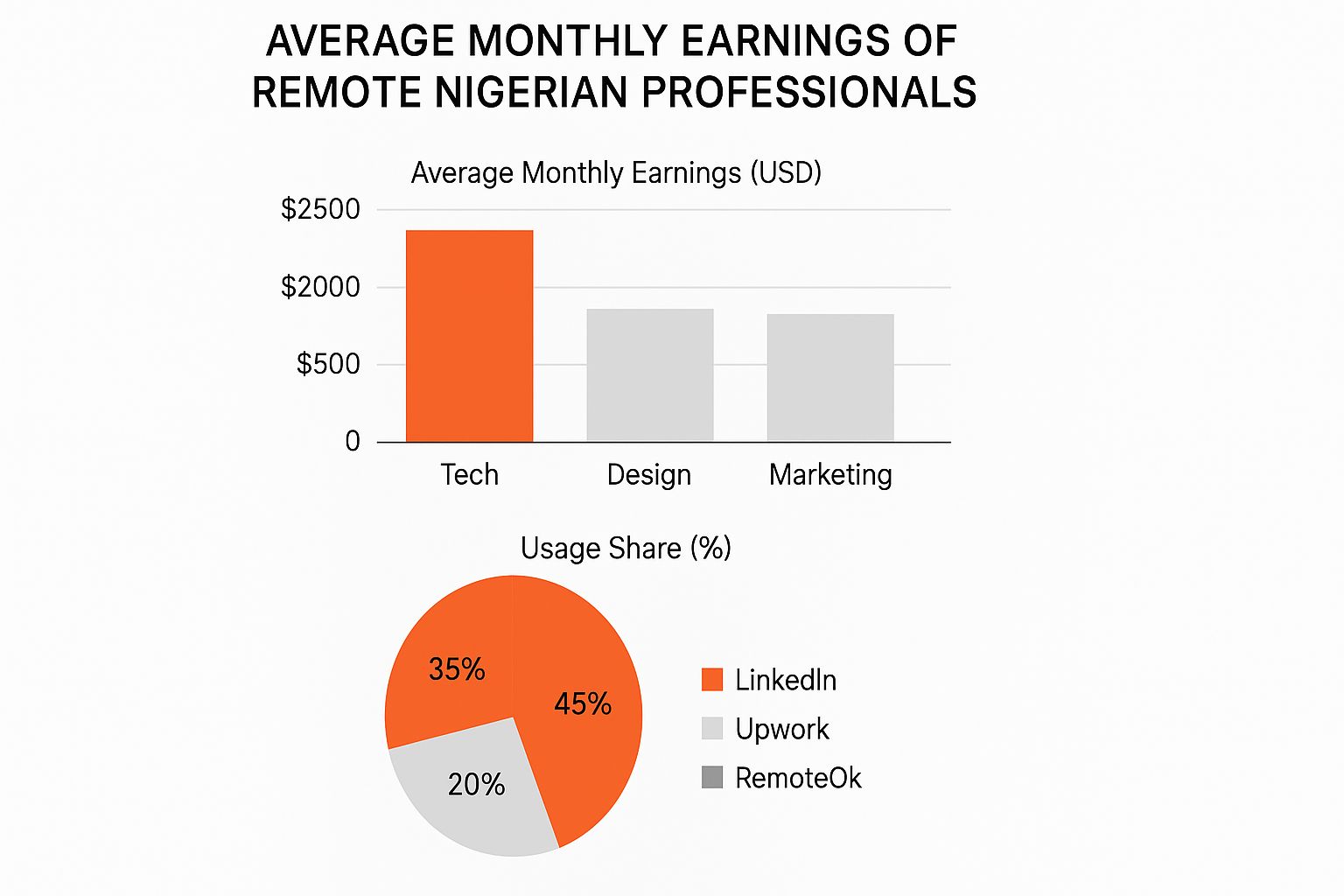
As you can see, tech roles are leading the pack in terms of earnings, and familiar grounds like LinkedIn are proving essential for Nigerians chasing global opportunities.
Choosing Your Payment Platform
So, how will your new employer actually pay you? Your regular Naira bank account probably won’t cut it for direct transfers in USD, EUR, or GBP. This is where international payment platforms become your best friend. They act as a bridge, giving you virtual foreign bank accounts so companies can pay you as easily as they would a local hire.
Here’s a rundown of the platforms I’ve seen people use most often:
- Deel: This one is often the employer’s choice. Companies use Deel as an all-in-one platform to hire, manage, and pay their international team. If they use it, you’ll be onboarded and paid through their system, which then lets you withdraw the funds to your Nigerian bank account. It’s very convenient.
- Payoneer: A long-time favourite for Nigerian freelancers and remote workers. Payoneer provides you with virtual accounts in several major currencies. It’s widely accepted and makes withdrawing to Naira straightforward, but keep an eye on the fees for transactions and currency conversion.
- Wise: Formerly known as TransferWise, Wise is famous for its transparency and fantastic exchange rates. It’s a brilliant option for receiving money because it uses the real mid-market rate for conversions, which can genuinely save you a lot of money compared to the competition.
My Two Cents: As soon as you get your contract, scan for the “Payment Terms.” This section will tell you how and when you’ll be paid. If the company gives you a choice, I’d suggest setting up both a Payoneer and a Wise account. This way, you can compare their rates each payday and always have a backup plan.
Comparing International Payment Platforms for Nigerians
Choosing the right platform can make a real difference to your take-home pay. Here’s a quick comparison to help you weigh your options based on what matters most to you.
| Platform | Best For | Average Fees | Withdrawal to Naira |
|---|---|---|---|
| Deel | Employer-mandated payments and contract management | Set by the employer, but often low-cost for contractors | Direct transfer; rates are competitive |
| Payoneer | Widespread acceptance and quick setup | ~2% currency conversion fee, plus transfer fees | Direct to bank account; usually arrives within a day |
| Wise | Best exchange rates and fee transparency | Low, fixed conversion fee (~0.5-1%) | Direct to bank account; known for fast transfers |
Ultimately, the “best” platform depends on your employer’s system and your personal priority—be it the lowest fees, fastest transfer, or widest acceptance. Having options is always a smart move.
Understanding Your Contract and Taxes
Treat your contract as your professional bible. It will clearly define your responsibilities, pay, and, crucially, your status as an independent contractor. This status means it’s your job to declare your income to Nigeria’s Federal Inland Revenue Service (FIRS) and handle your Personal Income Tax.
Once you start earning in a foreign currency, getting a handle on your finances becomes non-negotiable. It’s worth exploring strategies for cross-border financial planning to manage this new income stream effectively.
Also, be mindful that many tools you’ll use in a remote setting might rely on an automated system. It’s good practice to understand the ethical use of AI in the workplace to champion fairness in your career. My strongest advice? Find a good tax professional in Nigeria. The money you spend on their advice will save you headaches and potential trouble down the line.
Common Questions About International Remote Work
As you start looking into international remote jobs in Nigeria, you’re bound to have a few questions. That’s completely normal. Getting solid, practical answers is what will give you the confidence to take the next step. Let’s walk through some of the most common things Nigerian professionals ask when they start on this journey.
Do I Need a Visa to Work Remotely from Nigeria?
For the most part, no. If you’re living and working in Nigeria for a company based in another country, you’re working under Nigerian law. This means you don’t need a work visa for the country where the company is headquartered.
In nearly every scenario, the company will hire you as an independent contractor. A business visa might come into play only if the job requires you to travel abroad for things like team meetings or training, but the company will make this crystal clear during the interview process.
How Do I Handle My Taxes When Earning Foreign Currency?
This is a big one, so pay close attention. When you work as an independent contractor from Nigeria, you are 100% responsible for your own taxes. The foreign company won’t deduct any taxes from your pay.
Here is a practical, step-by-step approach:
- Register for a TIN: If you don’t have one, get a Tax Identification Number from the FIRS.
- Track All Income: Keep a meticulous record of every payment you receive, including the date and the amount in the original currency.
- File Your Tax Returns: You must declare all your income to the FIRS annually and pay your personal income tax.
- Consult a Professional: My strongest piece of advice? Talk to a Nigerian tax professional the moment you receive your first foreign payment. They can guide you, ensure you’re compliant, and help you find deductions you might not know about. This will save you a world of trouble.
What Are the Biggest Challenges I Might Face?
From my experience, the toughest hurdles often have less to do with your skills and more to do with our local infrastructure and communication. Think unreliable power, shaky internet connections, and figuring out the cultural nuances of workplace communication.
But here’s the thing: solving these problems before they become problems is what separates the pros from the amateurs.
- Practical Example for Power: Don’t just rely on a generator. Invest in an inverter system. It’s quieter, switches on instantly during a power cut, and can power your router and laptop for hours, ensuring you never drop off a call.
- Practical Example for Internet: Have a primary and a secondary internet plan from different providers (e.g., a fibre connection and a 4G/5G mobile hotspot). If one fails, you can switch to the other in seconds.
Are These Jobs Only for People in Tech?
Not at all! While tech roles like software development and data science are definitely popular, the field is opening up fast. We’re seeing huge growth in demand for:
- Virtual Assistants
- Customer Support Specialists
- Digital Marketers
- Content Creators
- Project Managers
Basically, if the job can be done on a computer, it has the potential to be an international remote role. Understanding how generative AI can transform industries can also point you toward new and exciting career paths you might not have considered.
Ready to create standout application materials that get noticed? RichlyAI provides powerful tools to generate compelling CVs, cover letters, and portfolio content, helping you present yourself as a top-tier global professional. Start creating for free with RichlyAI today!

Nice Post. Landing international remote jobs in Nigeria is a good opportunity. With the right skills and efforts, anyone can work with global companies.