
When you start looking into solar batteries in Nigeria, you’ll quickly see that prices can be all over the place. A good rule of thumb is to budget somewhere between ₦150,000 and ₦500,000 per kilowatt-hour (kWh) of storage capacity.
But that’s just a ballpark figure. The final cost really depends on the battery’s technology, the reputation of the brand, and its overall build quality. This guide will walk you through everything you need to know to make an informed decision, showing you how to calculate your needs and find the best value for your money.
Understanding the Solar Battery Price Landscape
Trying to figure out the solar battery market can feel overwhelming, but breaking down the costs is the key to making a smart decision. The sticker price you see is only the beginning. A much better way to compare your options is to look at the cost per kilowatt-hour (kWh).
This simple calculation tells you exactly how much you’re paying for every unit of energy the battery can store, giving you a true sense of its value.
Practical Example: Calculating Cost per kWh
Imagine two batteries:
- Battery A: A 5 kWh battery costing ₦900,000.
- Battery B: A 6 kWh battery costing ₦1,020,000.
At first glance, Battery A looks cheaper. But let’s calculate the cost per kWh:
- Battery A: ₦900,000 / 5 kWh = ₦180,000 per kWh
- Battery B: ₦1,020,000 / 6 kWh = ₦170,000 per kWh
Suddenly, Battery B is the better value, offering more storage for a lower price per unit of energy. As more Nigerians seek reliable power, knowing these details is crucial, and it’s also fueling new business opportunities in Nigeria’s renewable energy scene.
This infographic shows how the battery’s capacity and price tag come together to determine that all-important cost per kWh.
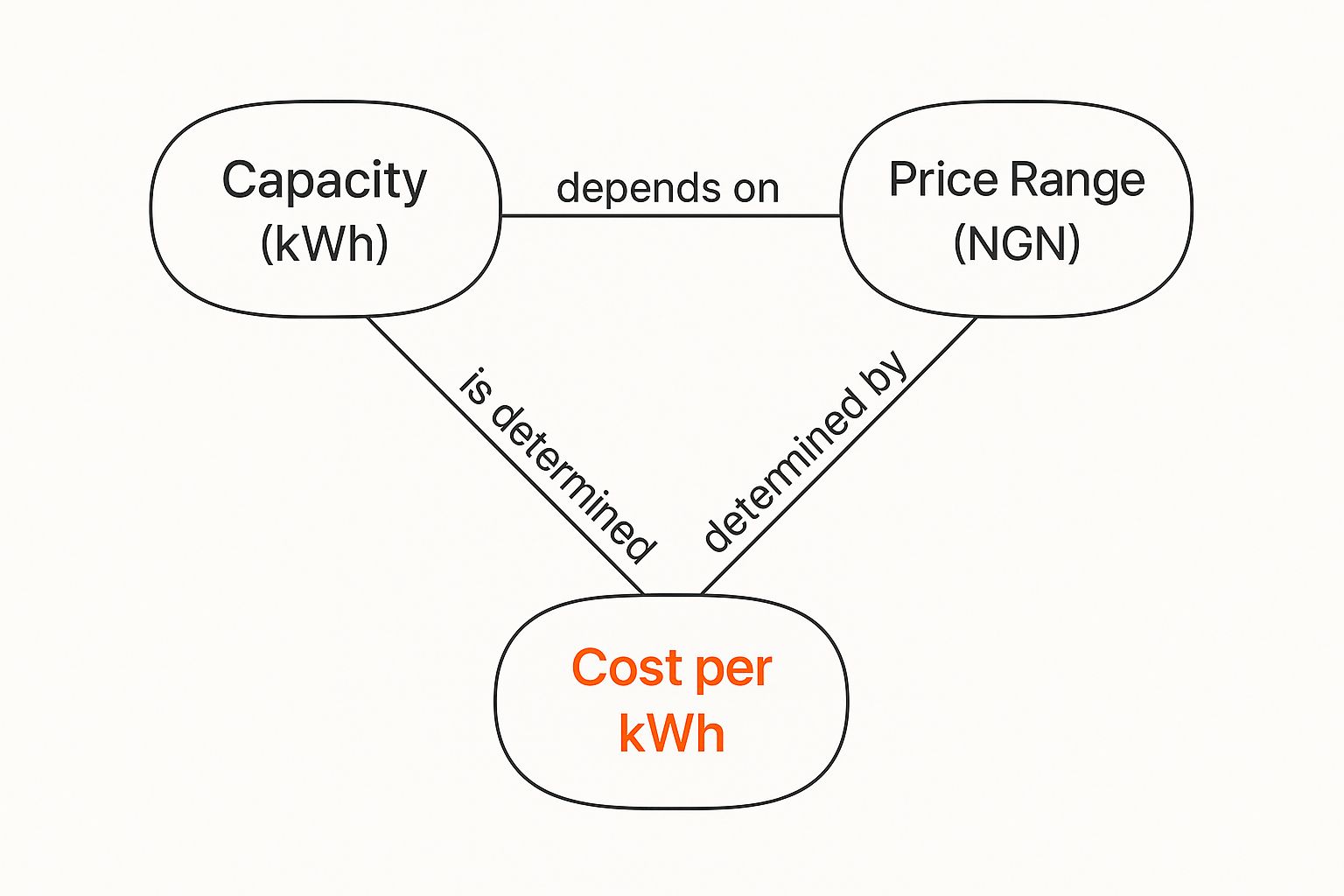
Alt text: Infographic showing how solar battery capacity and price range determine the cost per kilowatt-hour.
As you can see, you need to consider both the total storage size and the total price to really understand the value you’re getting from your investment.
Estimated Solar Battery Price Range in Nigeria by Capacity
To give you a clearer picture, here’s a quick breakdown of what you can expect to pay for different battery sizes in Nigeria. This table should help you match your needs to a realistic budget.
| Battery Capacity (kWh) | Primary Use Case | Estimated Price Range (NGN) |
|---|---|---|
| 5 kWh | Small homes, basic backup (lights, TV, fans) | ₦750,000 – ₦1,500,000 |
| 10 kWh | Average-sized homes, running major appliances | ₦1,500,000 – ₦3,000,000 |
| 15 kWh | Larger homes, small offices, near off-grid use | ₦2,250,000 – ₦4,500,000 |
| 20 kWh+ | Large residences, commercial use, full off-grid | ₦3,000,000 and up |
Remember, these are just estimates. The final price will always depend on the specific brand, technology, and installer you choose.
The Four Key Factors Driving Solar Battery Prices
Ever looked at two solar batteries that seem to do the same job but have completely different price tags? The price is a direct reflection of four critical factors, and understanding them is the key to making a smart investment.

Alt text: A technician installing a modern solar battery on a wall in a home.
When you look at a quote, you’re essentially paying for a mix of the battery’s energy storage, its internal technology, how much of that energy you can actually use, and the reliability of the company that made it. Let’s break down each of these so you can review any quote like a pro.
1. Battery Capacity (kWh)
The most straightforward factor is battery capacity, measured in kilowatt-hours (kWh). Think of it like the size of a fuel tank for your home. A bigger tank holds more energy and costs more.
- Actionable Insight: Use the step-by-step guide in this article to calculate your home’s daily energy needs. This ensures you buy a battery that’s large enough for your essentials without overspending on capacity you don’t need.
2. Battery Chemistry
Not all batteries are built the same. The chemical makeup dictates performance, lifespan, and cost. In Nigeria, you’ll mostly encounter two types: Lead-Acid and Lithium-ion.
- Lead-Acid: The older, traditional technology. Its biggest draw is the low upfront cost. The trade-off? A shorter lifespan, less efficiency, and the need for regular maintenance.
- Lithium-ion (LiFePO4): The modern standard. While the initial solar battery price is higher, these batteries can last for over 10 years, are far more efficient, and are maintenance-free.
- Actionable Insight: For long-term reliability and lower lifetime cost, a lithium-ion battery is the superior choice. If your budget is extremely tight, lead-acid can be a starting point, but plan for replacement costs.
3. Depth of Discharge (DoD)
Depth of Discharge (DoD) is the percentage of the battery’s stored energy you can safely use without causing damage. A higher DoD is always better because it means you can access more of the power you’ve stored.
- Practical Example: A 10 kWh lead-acid battery with a 50% DoD gives you only 5 kWh of usable energy. A 10 kWh lithium-ion battery with a 90% DoD gives you 9 kWh of usable energy.
- Actionable Insight: When comparing batteries, don’t just look at the total kWh. Always check the DoD. A battery with a higher DoD gives you more usable power for your money.
4. Brand and Warranty
A trusted brand invests in quality materials, rigorous testing, and solid customer support. That peace of mind is factored into the price.
- Actionable Insight: Look for a warranty of 10 years or more. This is your safety net and the manufacturer’s promise to stand by their product. Paying a bit more for a reputable brand often saves you the massive cost and headache of replacing a failed battery prematurely.
Lithium-Ion vs Lead-Acid: Which Battery Is Right for You?
Choosing between Lithium-ion and Lead-Acid batteries is a financial decision that directly shapes your long-term solar experience. Are you looking for the lowest price today, or are you investing for better performance and value down the line?
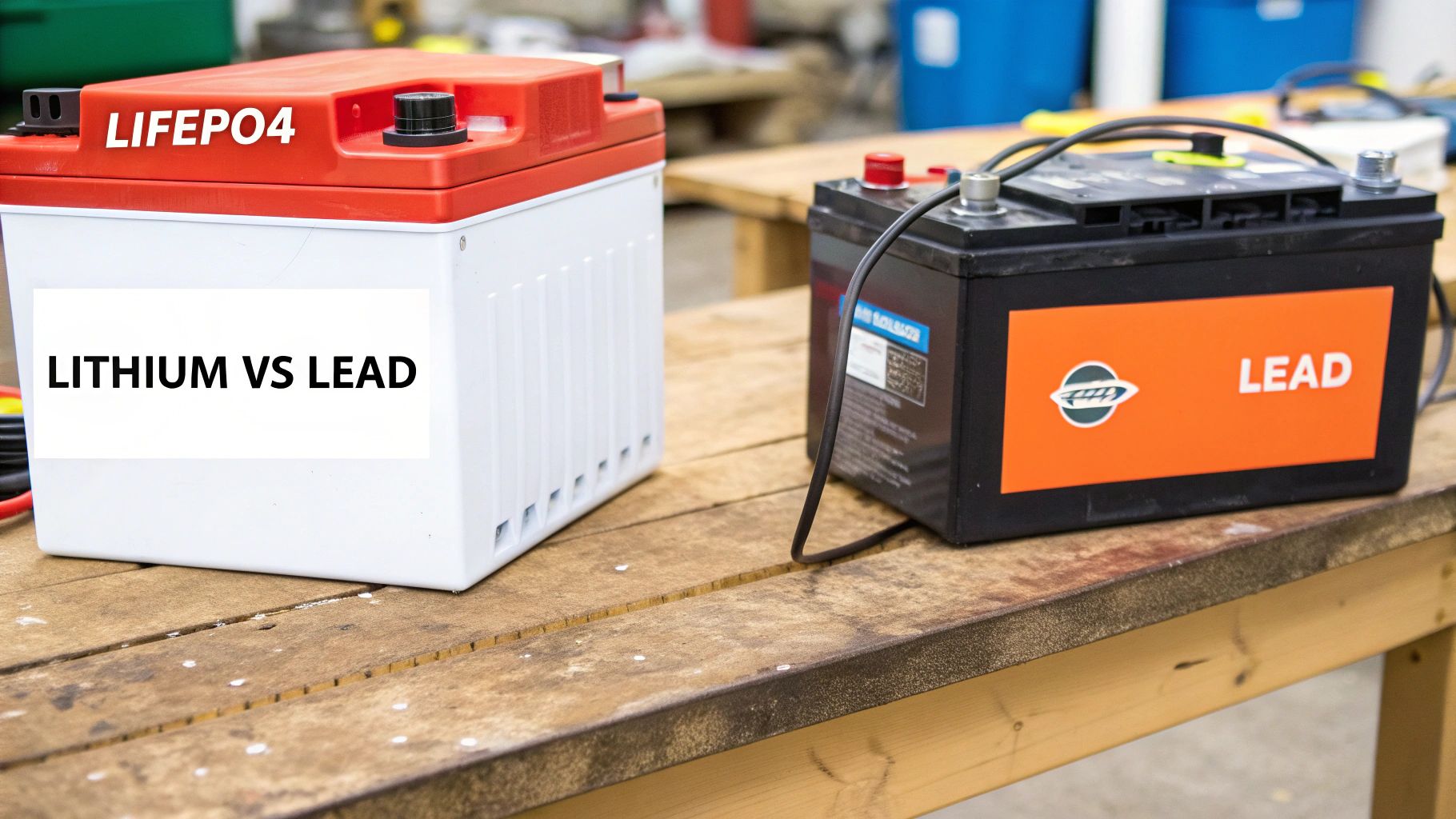
Alt text: A side-by-side comparison of a modern, sleek lithium-ion solar battery and a traditional lead-acid battery.
Lithium-Ion: The Long-Term Investment
Lithium-ion batteries, especially Lithium Iron Phosphate (LiFePO4) models, are the new gold standard. Think of them as the “buy it for life” option for anyone serious about reliable energy independence. Their standout feature is a lifespan that often exceeds 10 years.
Here’s what you get with a Lithium-ion battery:
- A Much Longer Lifespan: We’re talking 3,000 to 5,000+ cycles.
- Higher Efficiency: Around 95% efficiency means less wasted energy.
- Deeper Discharge: Safely use 80-95% of the battery’s capacity.
- Zero Maintenance: These are sealed, “set and forget” units.
- Compact & Lightweight: They pack more power into a smaller package.
The catch? The higher upfront solar battery price. However, as global prices continue to drop, they are becoming an increasingly smart investment for anyone who can manage the initial cost. You can learn more about how global trends impact local pricing for solar panel systems on ecoflow.com.
Lead-Acid: The Budget-Friendly Entry Point
Lead-acid batteries stick around for one simple reason: they are cheap. If your budget is the number one constraint, this technology is your most accessible gateway to storing solar power.
But this initial saving comes with compromises. Lead-acid batteries have a short lifespan of 2-5 years. They are also bulky, less efficient, and demand regular maintenance (like refilling distilled water in flooded versions).
Actionable Insight: Lead-acid batteries can work for small, non-essential backup systems. For a reliable, whole-home power solution, the frequent replacement costs often make them the more expensive option over the long term.
Feature Comparison: Lithium-Ion (LiFePO4) vs. Lead-Acid
This table breaks down the key metrics to simplify your decision.
| Feature | Lithium-Ion (LiFePO4) | Lead-Acid (AGM/Flooded) |
|---|---|---|
| Lifespan (Cycles) | 3,000 – 5,000+ | 300 – 1,000 |
| Typical Warranty | 10-15 years | 1-3 years |
| Efficiency | ~95% | ~80-85% |
| Depth of Discharge (DoD) | 80-95% | 50% (to preserve lifespan) |
| Maintenance | None | Regularly required (for flooded types) |
| Upfront Cost | High | Low |
| Long-Term Value | Excellent | Poor |
How to Correctly Size Your Solar Battery System
Getting your battery size right is arguably the most important step. It directly impacts the final solar battery price. Go too small, and you’ll run out of power. Go too big, and you’ve wasted money on unused capacity. The goal is to find the size that’s “just right.”
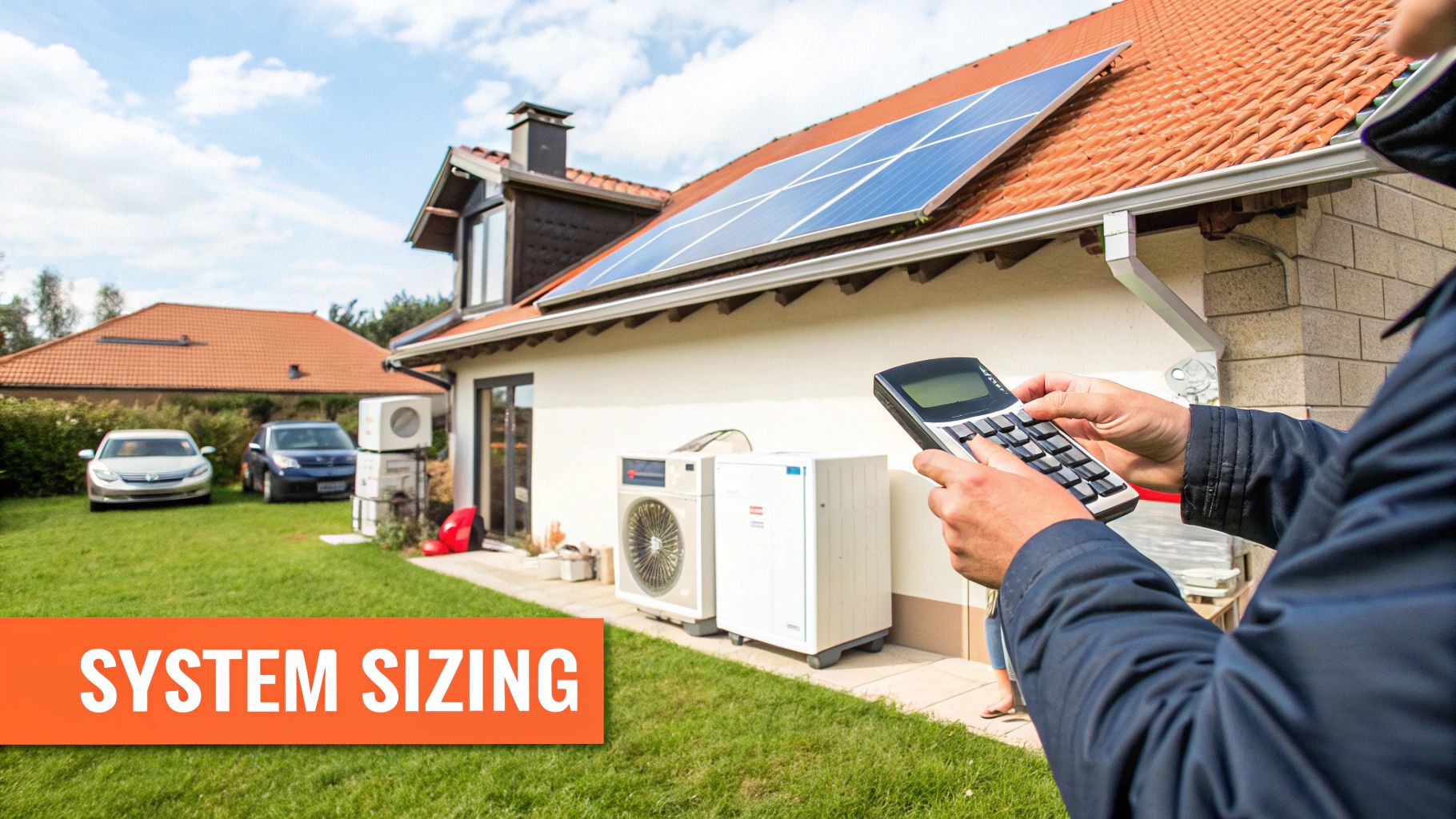
Alt text: A person using a calculator and notepad to plan their home energy needs, with a solar panel visible outside a window.
To do this, you need to perform a simple energy audit of your home. This process helps you pick a battery with the right capacity in kilowatt-hours (kWh).
A Step-by-Step Guide to Sizing Your Battery
Follow these four steps to take the guesswork out of sizing your system.
1. List Your Essential Appliances: Grab a notepad and list every appliance you need during a power outage (lights, fans, refrigerator, TV, device chargers). Be honest about what is essential.
2. Find Their Power Consumption (Watts): For each appliance, find its power consumption in watts (W). This is usually on a sticker on the device. If not, a quick online search for the model number will help.
3. Estimate Daily Usage (Hours): For each item, estimate how many hours it runs per day. Your fridge might run for a total of 8 hours over a 24-hour period, while your lights are on for 6 hours in the evening.
4. Calculate Your Total Daily Energy Need (kWh): Now, do the math.
- For each appliance, multiply its power (Watts) by its daily hours of use to get watt-hours (Wh).
- Add up the Wh for all appliances to get a grand total.
- Divide the total Wh by 1,000 to convert it to kilowatt-hours (kWh).
The Simple Formula: (Appliance Watts × Hours of Use) / 1,000 = Daily kWh
This final kWh figure is the minimum battery capacity you need to power your essentials for one day.
Practical Example: Sizing for a Nigerian Household
Let’s calculate the needs for a typical household.
| Appliance | Power (Watts) | Daily Use (Hours) | Daily Energy (Wh) |
|---|---|---|---|
| Refrigerator | 150 W | 8 | 1,200 Wh |
| LED Lights (x5) | 50 W (10W each) | 6 | 300 Wh |
| Ceiling Fans (x2) | 150 W (75W each) | 10 | 1,500 Wh |
| Television | 100 W | 4 | 400 Wh |
| Laptop/Phone Chargers | 70 W | 5 | 350 Wh |
| Total | 3,750 Wh |
To convert this to kWh, we divide by 1,000:
3,750 Wh / 1,000 = 3.75 kWh
Actionable Takeaway: Based on this calculation, a 5 kWh battery is an excellent choice. It covers the daily 3.75 kWh requirement and provides a buffer for inefficiency or extra usage, ensuring reliable power without overpaying for unused capacity.
Budgeting Beyond the Battery: Total System Costs
The price of the solar battery is just one part of the total cost. Forgetting the other essential components is a common mistake that can throw your budget off track. To get a realistic idea of the total solar battery price, you need to account for the components and skilled labor that make the system work.
The 15-25% Rule for Accurate Budgeting
A solid rule of thumb is to add an extra 15% to 25% on top of the battery’s price to cover all necessities.
This extra amount typically covers:
- Solar Inverter: The heart of your system, converting DC power from your battery into the AC power your home uses.
- Mounting Racks & Wiring: High-quality cables and secure mounting are essential for safety and efficiency.
- Professional Installation Labour: This is not a place to cut corners. A certified professional ensures your system is safe, efficient, and that your warranty remains valid.
Actionable Insight: When requesting quotes, ask for a detailed, itemized list that includes the battery, inverter, wiring, and installation labor. This gives you a clear picture of the total investment and helps you compare offers accurately. Trying to DIY a high-voltage electrical system is extremely dangerous and will void your warranty.
The drive for energy independence has seen a massive increase in solar installations, with complete systems for a home typically falling between ₦400,000 and ₦1,500,000. You can learn more about the factors driving solar adoption in Nigeria from Solar.com.
If the total amount feels steep, don’t be discouraged. There are often financing options available. For some ideas on managing larger expenses, our guide on the best apps to borrow money can be a helpful place to start your research.
Actionable Tips for Finding the Best Solar Battery Deal
*Video: A guide on how solar batteries work and factors to consider when buying.*
Finding a great solar battery price is about spotting long-term value, not just the lowest upfront cost. A little strategy goes a long way.
The golden rule? Never take the first offer. Always get multiple quotes to compare.
How to Shop Smart for Your Solar Battery
A methodical approach will help you compare apples to apples. Here is a step-by-step process you can follow:
- Get at least three itemized quotes. Contact reputable installers in your area and ask for detailed quotes. Don’t just look at the total cost; compare the quality and specs of the proposed inverter and battery.
- Ask about financing and discounts. Many installers offer payment plans or Pay-As-You-Go options. Also, check for any government incentives or seasonal promotions that could lower the price.
- Consider a modular system. You don’t have to buy your “forever system” right away. A modular, expandable setup allows you to install what you can afford now and easily add more battery capacity later.
- Focus on long-term value. A slightly more expensive battery that lasts twice as long is the smarter financial choice. Always ask about the cost per cycle or the warranted lifespan to understand what you’re really getting for your money.
By following these steps, you’ll be in a much better position to navigate the market and make an investment that delivers both reliable power and financial peace of mind. Thinking through your financial strategy is just as crucial as picking the right technology, much like how you would use the best investment platforms in Nigeria to plan for long-term growth.
Final Takeaways: Your Next Steps
Here are the key actions you can take right now to find the right solar battery at the right price:
- Calculate Your Energy Needs: Use the step-by-step guide in this article to perform a quick energy audit of your home. This is your most important first step.
- Decide on Battery Chemistry: For most homes needing reliable power, a Lithium-ion (LiFePO4) battery offers the best long-term value despite a higher upfront cost.
- Get Three Itemized Quotes: Contact at least three professional installers and ask for detailed quotes that break down the cost of the battery, inverter, and installation.
- Compare Based on Value, Not Just Price: Look at the cost per kWh, the Depth of Discharge (DoD), and the warranty length to determine the true value of each offer.
- Ask About Modular Systems: If the initial cost is too high, ask for an expandable system that allows you to add more battery capacity in the future.
Tools & Further Reading
- Energy Consumption Calculator: RENVU Solar Calculator – An online tool to help estimate your daily energy usage.
- Understanding Solar Systems: Learn about solar panel systems on ecoflow.com
- Market Trends in Nigeria: Analysis of solar adoption in Nigeria from Solar.com
Ready to power your home or business with clean, reliable energy? RichlyAI can help you create compelling content to explain the benefits of solar power. Explore our AI-powered tools at RichlyAI Hub to generate marketing copy, articles, and more.
