
Nigeria’s business landscape is often defined by towering figures whose names are synonymous with success. But beyond the well-known stories of wealth and influence lies a blueprint of strategy, resilience, and tactical genius. This article moves past the surface-level success narratives to dissect the specific, replicable methods that have propelled some of the most successful entrepreneurs in Nigeria to the top of their industries. We will not just list names; we will deconstruct their business models, analyse their market entry strategies, and pinpoint the pivotal decisions that created lasting empires.
Forget generic advice. Instead, you will find a detailed breakdown of the actionable frameworks these titans employed. From Aliko Dangote’s mastery of supply chain integration to Jason Njoku’s disruptive approach to digital content distribution, each profile is a case study in strategic execution. The goal is to equip you with practical insights and tactical takeaways that you can apply to your own entrepreneurial journey. We will explore how they identified market gaps, secured funding, scaled operations, and built enduring brands against formidable odds. This is not just a list of accomplishments; it is a strategic playbook drawn from Nigeria’s most formidable business minds.
1. Aliko Dangote – Dangote Group
Aliko Dangote, Africa’s richest individual, stands as a monumental figure among successful entrepreneurs in Nigeria. His journey with the Dangote Group, from a small trading firm to a multi-billion dollar industrial conglomerate, is a masterclass in strategic expansion and market domination by focusing on fundamental human needs.
Starting with a modest loan of $3,000 from his uncle in 1977, Dangote initially traded commodities like sugar, salt, and rice. Instead of remaining a trader, he strategically pivoted to manufacturing these essential goods, a move that laid the foundation for his empire. This principle of focusing on non-negotiable consumer staples, such as cement, sugar, and flour, ensured consistent demand regardless of economic cycles.
Strategic Analysis: The Power of Backward Integration
Dangote’s core strategy is backward integration. This involves taking control of the supply chain by acquiring or creating the businesses that supply raw materials. For example, instead of just bagging and selling cement, Dangote Group built its own plants, quarried its own limestone, and even generated its own power.
“To succeed in business, you must build a brand and never destroy it. One competitive advantage I had when I ventured into manufacturing was my brand (Dangote), which I diligently built in the course of my trading.”
This approach provided three critical advantages:
- Cost Control: It dramatically reduced reliance on external suppliers and shielded the business from price volatility.
- Quality Assurance: Direct oversight of the entire production process ensured a consistent and high-quality product.
- Supply Chain Resilience: It eliminated dependencies that could disrupt production, giving Dangote a massive competitive edge.
Practical Example: Applying Backward Integration
Imagine you run a small but popular fruit juice business. You currently buy your oranges from a wholesale market.
- Step 1 (Current State): You are a processor. You depend on market prices and fruit quality.
- Step 2 (Backward Integration): You lease a small plot of land and start your own orange farm. You now control the supply of your primary raw material.
- Step 3 (Outcome): You can control the quality of the oranges, stabilise your production costs, and ensure you always have a supply, even when market prices spike. You have integrated backward into farming.
The upcoming Dangote Refinery, with a capacity of 650,000 barrels per day, is the ultimate expression of this strategy, designed to make Nigeria a net exporter of petroleum products and control the entire value chain.
Visualising the Journey: From Seed Capital to Continental Leader
The following timeline visualises key milestones in the Dangote Group’s incredible growth trajectory, highlighting its evolution from a small startup to a dominant African conglomerate.
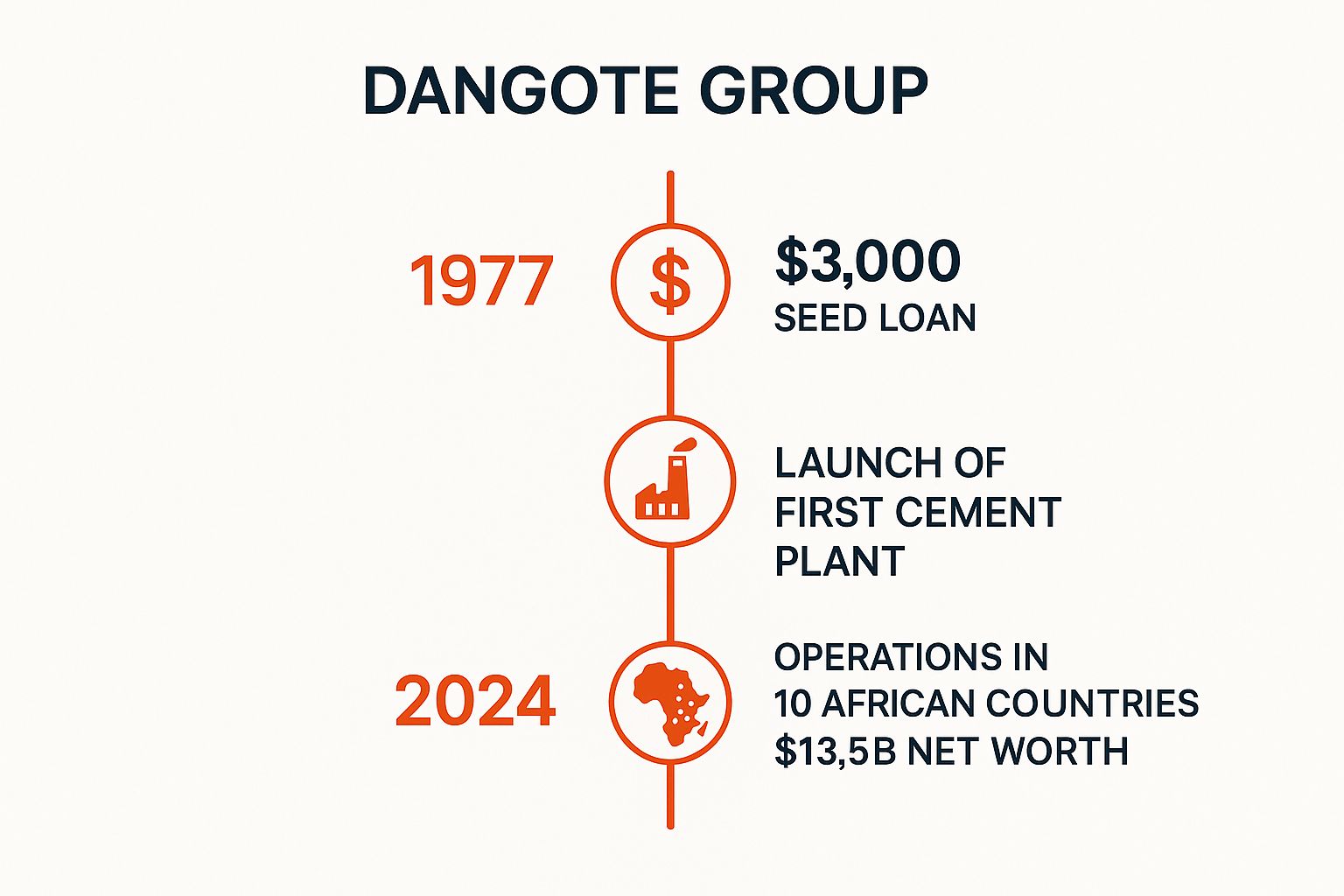
This visualisation clearly shows how patient, strategic reinvestment over decades can transform a small initial capital into an industrial powerhouse with a vast continental reach.
Actionable Takeaways
- Solve Basic Needs: Identify a product or service that is a fundamental necessity. This creates stable, predictable demand.
- Control Your Supply Chain: Map your production process. Identify key suppliers and assess the risk of dependency. Can you bring any part of that supply in-house?
- Reinvest Profits for Growth: Create a policy for reinvestment. For example, commit to reinvesting 70% of all profits back into the business for the first five years to fund expansion.
- Think Big, Start Small: Start with a simple model (like trading) to understand the market deeply before investing capital in a more complex one (like manufacturing).
2. Tony Elumelu – United Bank for Africa (UBA) & Heirs Holdings
Tony Elumelu is a visionary banker, investor, and philanthropist whose influence extends far beyond Nigeria. He is one of the most celebrated successful entrepreneurs in Nigeria, renowned for transforming a distressed bank into the pan-African powerhouse, United Bank for Africa (UBA). His journey champions a philosophy he termed ‘Africapitalism’, advocating for long-term, strategic investments in key sectors to create both economic prosperity and social wealth.
Beginning his career by leading a small group of investors to take over the struggling Crystal Bank in 1997, Elumelu demonstrated a unique talent for turnarounds. Renaming it Standard Trust Bank, he grew it into a top-five financial institution before engineering the largest merger in sub-Saharan African banking history with UBA in 2005. This strategic move created a financial services giant that now operates in over 20 African countries and major global financial hubs.
Strategic Analysis: The Philosophy of Africapitalism
Elumelu’s core philosophy is Africapitalism. This is a strategic approach where the private sector commits to long-term investments in critical African sectors to generate economic returns while simultaneously creating social good and development. It is about investing with a purpose beyond just profit.
“Africapitalism is the private sector’s commitment to Africa’s development through long-term investment in strategic sectors of the economy that create both economic prosperity and social wealth.”
This philosophy translates into a three-pronged investment strategy:
- Long-Term Vision: Unlike speculative short-term plays, Africapitalism focuses on building sustainable, institutionally sound businesses in sectors like finance, power, and healthcare.
- Ecosystem Building: It involves creating value across the continent by empowering the next generation. The Tony Elumelu Foundation, which has funded over 18,000 African entrepreneurs, is a prime example of building a supportive ecosystem.
- Strategic Diversification: Through Heirs Holdings, Elumelu applies this model across various sectors, from hospitality (Transcorp Hilton) to oil and gas, creating a resilient and impactful portfolio.
Practical Example: Building an Ecosystem
A software development agency can practice Africapitalism by:
- Step 1 (Core Business): Building software for corporate clients (economic prosperity).
- Step 2 (Ecosystem Building): Launching a free coding bootcamp for local youth, training them in the skills the agency needs (social wealth).
- Step 3 (Outcome): The agency gets access to a pipeline of trained, loyal talent. The community benefits from skills development and job creation. The business and the ecosystem grow together.
Making informed decisions on where to invest is crucial, and understanding the options available on the best investment platforms in Nigeria is a great starting point for aspiring investors.
Actionable Takeaways
- Invest with a Purpose: Define your business’s “social mission” alongside its financial goals. How does your success benefit your community?
- Think Long-Term: Prioritise building strong corporate governance and investing in your team over chasing quick profits.
- Empower Others: Identify a way to support your industry’s ecosystem. This could be through mentorship, training programs, or investing in smaller startups.
- Identify Turnaround Opportunities: Look for undervalued or struggling businesses with strong underlying potential that a strategic vision can transform.
3. Folorunso Alakija – Famfa Oil & Rose of Sharon Group
Folorunso Alakija’s story is a powerful testament to strategic pivoting and the art of leveraging success in one industry to conquer another. Her journey from a high-end fashion designer to an oil magnate makes her one of the most formidable and successful entrepreneurs in Nigeria, showcasing how expertise and reputation can be powerful currencies for diversification.
She initially established her reputation with Supreme Stitches, a fashion label that catered to Nigeria’s elite, including First Ladies. Instead of limiting her ambitions to fashion, she astutely used her high-level network and credibility to explore opportunities in the capital-intensive oil and gas sector. This led to the creation of Famfa Oil, which was awarded an oil prospecting licence for the prolific OPL 216 block.
Strategic Analysis: The Power of Credibility Leverage and Sector Pivoting
Alakija’s core strategy was credibility leverage and strategic sector pivoting. She built an impeccable brand in one industry (fashion) and then translated the trust, reputation, and network gained from it into an opportunity in a completely different, high-barrier-to-entry sector (oil).
“There is no ‘secret’ to success. It’s the result of preparation, hard work, and learning from failure.”
This approach provided three distinct advantages:
- Access to Opportunities: Her established network provided access to opportunities that would be unavailable to an unknown entity.
- Building Trust: Credibility from her first venture made potential partners and regulators more willing to engage with her on a new, high-stakes project.
- Resilience through Diversification: By moving from fashion to oil and later into real estate and philanthropy, she built a diversified portfolio that is resilient to sector-specific downturns.
Practical Example: Leveraging Credibility for a Pivot
A successful digital marketing agency owner wants to enter the real estate development market.
- Step 1 (Build Credibility): The owner spends years building a top-tier agency known for delivering results for high-net-worth clients.
- Step 2 (Leverage Network): She approaches her existing clients—who trust her business acumen—with a proposal for a small joint-venture real estate project, seeking their investment.
- Step 3 (Outcome): Her reputation for excellence in marketing provides the trust needed to secure funding for her new venture, allowing her to pivot successfully into a new industry.
Her long legal battle to retain her stake in the Agbami oilfield, which now produces over 200,000 barrels per day, demonstrates the tenacity required to see such a bold pivot through to its successful conclusion.
Actionable Takeaways
- Build Your Brand First: Focus on achieving excellence and a stellar reputation in your current field. This credibility is your most valuable asset.
- Network Across Industries: Intentionally build relationships in sectors you aspire to enter. Join industry associations or attend conferences outside your immediate field.
- Leverage Success for New Ventures: Use the cash flow, reputation, and network from a successful business to fund and de-risk your entry into a new, more ambitious area.
- Be Tenacious: Pivoting into high-stakes industries often involves significant challenges. Be prepared for a long and difficult fight.
4. Jim Ovia – Zenith Bank
Jim Ovia is a towering figure among successful entrepreneurs in Nigeria, transforming the nation’s financial landscape with Zenith Bank. He founded the institution in 1990 with just $4 million, pioneering a new era of banking driven by technology, superior customer service, and robust corporate governance. His journey demonstrates how a clear vision for innovation can disrupt an established industry.
From its inception, Zenith Bank was designed to be different. While competitors relied on traditional brick-and-mortar models, Ovia championed early adoption of technology and a strong service-oriented culture. This forward-thinking approach allowed the bank to scale rapidly, becoming one of Africa’s largest and most profitable financial institutions and the first Nigerian bank to be listed on the London Stock Exchange.
Strategic Analysis: The Power of Institutional Culture and Tech Adoption
Ovia’s core strategy was building a powerful institutional culture underpinned by aggressive technology adoption. He understood that to compete, the bank needed systems, processes, and a workforce that prioritised excellence, transparency, and customer satisfaction above all else. This was not just a goal but an operational framework.
“I saw a gap in the banking industry and I decided to create a bank that would be different from the rest. A bank that would be customer-focused, technology-driven and highly professional.”
This dual focus on people and technology created a formidable competitive advantage:
- Operational Efficiency: Investing in IT infrastructure from day one streamlined operations, reduced costs, and enabled faster service delivery than competitors.
- Customer Trust: A strong focus on corporate governance and transparency built immense trust with customers and investors, crucial in the financial sector.
- Talent Magnet: The culture of professionalism and meritocracy attracted and retained the best talent, creating a highly skilled and motivated workforce.
Practical Example: Building a Tech-First Culture
A new logistics company wants to compete with established players.
- Step 1 (Identify a Tech Lever): Instead of just buying vans, the founder first invests in a cutting-edge routing and tracking software.
- Step 2 (Build Culture Around It): All staff, from drivers to dispatchers, are trained to be “data-driven.” Performance is measured by metrics from the software (e.g., on-time delivery percentage, fuel efficiency).
- Step 3 (Outcome): The company operates more efficiently, provides better tracking for customers, and can offer more competitive pricing, all driven by its tech-first culture.
Zenith Bank’s early rollout of internet banking and digital platforms in Nigeria is a direct result of this strategy, positioning it as a leader long before “fintech” became a buzzword.
Actionable Takeaways
- Embed Technology from Day One: Don’t treat tech as an afterthought. Use it to solve a core business problem—efficiency, customer experience, or scale.
- Define and Live Your Culture: Write down your company’s core values. Hire, promote, and fire based on those values to build a strong, consistent culture.
- Prioritise Governance: From the start, establish clear financial controls and transparent reporting, even if you are a one-person business. This builds trust with stakeholders.
- Map the Customer Journey: Analyse every touchpoint a customer has with your business and use technology to make each step as seamless as possible.
5. Jason Njoku – iROKOtv
Jason Njoku is a pivotal figure among successful entrepreneurs in Nigeria, recognised for catalysing a digital revolution in Africa’s film industry. His company, iROKOtv, often dubbed the ‘Netflix of Africa,’ solved the monumental challenge of content distribution for Nollywood, creating a legal and profitable global streaming service for a once-fragmented market.

Njoku identified a gaping hole in the market: a massive global diaspora and continental audience desperate for Nollywood content, but with no legitimate way to access it online. By licensing movies directly from producers and streaming them online, he organised a chaotic industry, provided a new revenue stream for creators, and built a multi-million dollar tech company from the ground up, attracting over $40 million in venture capital.
Strategic Analysis: The Power of First-Mover Advantage in a Niche Market
Njoku’s core strategy was a first-mover advantage in a culturally specific digital niche. While others saw piracy and infrastructural challenges, he saw a disorganised market ripe for technological disruption. By moving quickly to secure exclusive digital rights, he built a content library that was impossible for competitors to replicate.
“I am just a normal guy who had a passion and a problem. The passion was Nollywood and the problem was I couldn’t watch it. So I created the solution.”
This approach delivered several key advantages:
- Building a Content Moat: Securing exclusive licenses created a strong competitive barrier. Anyone else entering the market would struggle to acquire a comparable catalogue.
- Market Education: As the first major player, iROKOtv defined the market, educated consumers on streaming, and established the brand as the go-to source for Nollywood.
- Attracting Investment: Being the pioneer with a proven model made iROKOtv an attractive investment for venture capitalists like Tiger Global who were looking for high-growth African opportunities.
Practical Example: Capturing a Niche Market
An entrepreneur notices that there are no reliable online stores for high-quality, locally made Aso-Oke fabric.
- Step 1 (Identify the Niche): The target market is Nigerian brides in the diaspora and at home who want authentic Aso-Oke.
- Step 2 (Move First & Build a Moat): The entrepreneur travels to weaving communities in Iseyin and signs exclusive digital distribution deals with the top 10 weaver families.
- Step 3 (Outcome): She launches an e-commerce site with the best, exclusive collection. Competitors cannot easily replicate her supply chain, giving her a first-mover advantage.
His expansion into content creation with ROK Studios further deepened this moat, turning iROKO from a distributor into a vertically integrated media powerhouse.
Visualising the Journey: From YouTube Channel to Global Streaming Service
This video interview provides a deeper look into the early struggles, strategic pivots, and visionary thinking that propelled iROKOtv from a simple idea into a global entertainment brand. It captures the essence of Njoku’s entrepreneurial journey.
Actionable Takeaways
- Digitise an Analogue Industry: Look for a successful traditional industry in your region that lacks an organised digital presence. Be the one to build it.
- Target the Diaspora: If your product has cultural relevance, the diaspora can be a powerful initial market with higher purchasing power and better infrastructure.
- Secure Exclusive Rights: In any business based on intellectual property (content, software, design), lock down exclusive rights to build a competitive advantage.
- Solve Your Own Problem: The most authentic business ideas often come from solving a problem you have personally experienced.
6. Sim Shagaya – Konga, uLesson
Sim Shagaya is a prime example of a serial entrepreneur who embodies resilience and strategic evolution, making him one of the most respected successful entrepreneurs in Nigeria. His journey from founding DealDey to building the e-commerce giant Konga and later pivoting to create the ed-tech platform uLesson demonstrates a powerful ability to identify, build, and scale solutions for major market gaps.
After a successful career in the military and finance abroad, Shagaya returned to Nigeria and founded DealDey, a daily deals website that quickly gained traction. He then launched Konga in 2012, building it into a formidable competitor to Jumia by focusing on logistics and trust. Following his exit from Konga, he identified a critical need in the education sector, leading him to found uLesson, an app designed to make quality education accessible across Africa.
Strategic Analysis: The Art of the Pivot
Shagaya’s core strategy is market-driven pivoting. Unlike entrepreneurs who stick to one industry, he masterfully identifies large, underserved markets, builds a robust operational solution, and is not afraid to exit and channel his experience into a new, more impactful venture. His move from e-commerce to ed-tech was a calculated pivot based on a deep understanding of Africa’s demographic needs.
“I think what’s important is to really be solving a problem. Be brutally honest with yourself: Is the problem you’re solving a real problem or a nice-to-have?”
This approach gives him three key advantages:
- Problem-First Mindset: He focuses intensely on solving a fundamental user problem, whether it’s access to goods (Konga) or quality education (uLesson).
- Transferable Expertise: He leverages lessons from previous ventures, particularly in logistics, technology, and fundraising, to accelerate the growth of his next company.
- Investor Confidence: His track record of building and exiting successful businesses builds trust with investors, enabling him to raise significant capital for new ideas, as seen with uLesson’s $22 million funding.
Practical Example: A Strategic Pivot
The owner of a successful corporate event planning company sees the market decline during the pandemic.
- Step 1 (Analyze Skills & Market Shift): She identifies that her core skills are logistics, vendor management, and creating great user experiences. She also sees the explosion in demand for home delivery services.
- Step 2 (Pivot): She pivots her business from corporate events to “curated experience boxes” for remote teams—packaging and delivering high-quality kits for virtual wine tastings, workshops, etc.
- Step 3 (Outcome): She uses her existing logistics and vendor network to serve a new, growing market, successfully pivoting instead of shutting down.
This journey highlights how diverse ventures can become a legit online business that pays daily when a real market need is met with a solid operational plan.
Actionable Takeaways
- Solve Foundational Problems: Look for large, persistent problems in society that technology can solve. These often represent the biggest opportunities.
- Don’t Fear the Pivot: Your business model is not sacred. Be willing to change it if the market tells you to. Your experience is your greatest asset for the next chapter.
- Build Strong Operational Systems: Invest in the non-glamorous operational backbone of your business—logistics, customer service, and finance—from day one.
- Treat Each Venture as a Lesson: After every major project (success or failure), conduct a post-mortem. What worked? What didn’t? Apply these learnings to your next move.
7. Ngozi Okonjo-Iweala & Arunma Oteh – Breaking Barriers in Finance (Entrepreneurial Leadership)
While not entrepreneurs in the traditional sense of building a private company, Ngozi Okonjo-Iweala and Arunma Oteh are prime examples of institutional entrepreneurship. They leveraged leadership roles within public and international bodies to reform complex systems, creating the stable, transparent frameworks that private enterprise needs to thrive. Their careers demonstrate how entrepreneurial thinking can transform national economies.
Okonjo-Iweala, as Nigeria’s Finance Minister, and Oteh, as Director-General of the Securities and Exchange Commission (SEC), tackled systemic rot with the mindset of a turnaround CEO. Okonjo-Iweala’s negotiation of an $18 billion debt write-off from the Paris Club was a monumental strategic win, freeing up capital for national development. Oteh’s reform of the Nigerian capital market after the 2008 financial crisis restored investor confidence by enforcing strict compliance and transparency.
Strategic Analysis: The Power of Institutional Entrepreneurship
The core strategy here is institutional entrepreneurship: applying entrepreneurial principles like innovation, risk-taking, and value creation to reform public institutions. Instead of creating a product, these leaders “re-engineered” the economic operating system of Nigeria itself. They identified critical failures, designed innovative solutions, and relentlessly implemented them against immense political resistance.
“I believe that when you find problems, you should also find solutions.” – Ngozi Okonjo-Iweala
This approach delivers value on a national scale by:
- Creating a Predictable Environment: Strong, transparent institutions reduce risk and uncertainty, making it safer for both local and foreign entrepreneurs to invest.
- Unlocking Economic Potential: Reforms like the Treasury Single Account (TSA) plug financial leakages, while capital market reforms make it easier for businesses to raise funds.
- Building Foundational Trust: Their unwavering commitment to integrity and transparency rebuilt trust in Nigeria’s financial systems, a critical asset for long-term growth.
Actionable Takeaways
- Think Like a System Builder: In your own company, build robust systems and processes that outlast you. Document everything from sales procedures to hiring checklists.
- Integrity is a Competitive Advantage: Build a reputation for unwavering integrity. In a market where trust is scarce, it becomes your most valuable asset.
- Seek International Best Practices: Gain exposure to how the best companies in your field operate globally. Adapt their world-class standards to your local market.
- Drive Change From Your Position: You don’t need to be the CEO to be an entrepreneur. Identify a broken process within your sphere of influence and take the initiative to fix it.
8. Chinedu Echeruo – HopStop & Gigameet
Chinedu Echeruo is a pivotal figure among successful entrepreneurs in Nigeria, proving that local talent can build globally impactful technology solutions. His journey with HopStop, a mobile navigation service he founded and later sold to Apple for a reported $1 billion, is a powerful case study in identifying a universal urban problem and solving it with scalable technology.
After working as an analyst at several investment banks, Echeruo launched HopStop in 2005 to simplify public transport navigation, a challenge he faced daily in New York City. The service provided detailed, door-to-door transit directions, a revolutionary concept at the time. By the time of its acquisition, HopStop was serving millions of users in over 600 cities, demonstrating the immense value of solving a widespread, persistent problem.
Strategic Analysis: Solving Universal Problems with a Global Mindset
Echeruo’s core strategy was to build for a global audience from day one. Unlike businesses focused purely on a local market, he identified a pain point common to nearly every major city dweller worldwide: navigating complex public transit systems. This universal applicability made HopStop an attractive asset for a global tech giant like Apple.
“I believe in solving problems. If you solve a problem, you get paid for it. The bigger the problem, the more you get paid. My goal is to solve big problems for a large number of people.”
This approach provided several key advantages:
- Scalability: The solution wasn’t limited by geography. Once the core technology was built, it could be adapted and rolled out to new cities relatively easily.
- High-Value Exit Potential: Global tech companies are constantly seeking to acquire technologies that can be integrated into their existing ecosystems to serve billions of users. HopStop was a perfect fit for Apple Maps.
- Market Leadership: By being an early mover in the transit navigation space, HopStop established a strong brand and user base before competitors could catch up.
Practical Example: Building with an Exit in Mind
A startup founder creates a powerful AI-powered plugin for Nollywood scriptwriting.
- Step 1 (Identify a Universal Problem): Scriptwriting formatting and character tracking is a universal problem for all screenwriters.
- Step 2 (Build with an Exit in Mind): The founder builds the plugin to easily integrate with popular software like Final Draft and notes that streaming giants like Netflix or Amazon Prime Video are heavily investing in original African content.
- Step 3 (Outcome): The plugin gains traction. Because it solves a key problem for a growing content sector, it becomes an attractive acquisition target for a major streaming platform looking to streamline its production pipeline in Africa.
His new venture, Gigameet, which competes in the video collaboration space, follows a similar principle of tackling a globally relevant business challenge.
Actionable Takeaways
- Identify Universal Pain Points: Ask yourself: “Is this problem unique to my city, or does everyone in a similar role face this globally?”
- Build for Integration: From the start, consider what kind of company would find your technology valuable. Design your product so it can be easily integrated into a larger platform.
- Focus on Execution: Great tech ideas can originate anywhere. Don’t be limited by geography; focus on building a world-class product.
- Invest Back into the Ecosystem: After a success, consider how you can use your capital and experience to fund and mentor the next generation of entrepreneurs in your home market. As entrepreneurs increasingly harness technology, they can discover more about how SMEs in Africa can use AI for growth.
Profiles and Impact Comparison of 8 Nigerian Entrepreneurs
| Entrepreneur | Implementation Complexity 🔄 | Resource Requirements ⚡ | Expected Outcomes 📊 | Ideal Use Cases 💡 | Key Advantages ⭐ |
|---|---|---|---|---|---|
| Aliko Dangote – Dangote Group | High – complex vertical integration and infrastructure | Very high – capital-intensive manufacturing & energy | Large-scale industrial dominance and job creation | Essential commodities, manufacturing, energy sectors | Strong supply chain control; long-term vision |
| Tony Elumelu – UBA & Heirs Holdings | High – turnaround + multi-sector management | Very high – banking, investments, large capital | Pan-African financial services growth; entrepreneurship funding | Banking, investments, energy, and entrepreneurship ecosystems | Systematic entrepreneurship development; youth focus |
| Folorunso Alakija – Famfa Oil & Rose of Sharon | Moderate to high – sector pivots with legal complexity | High – oil exploration & fashion | Wealth from oil and diversified businesses | Fashion transitioning to oil & gas, real estate | Successful industry pivoting; strong networking |
| Jim Ovia – Zenith Bank | High – tech-driven banking innovation | Very high – capital, technology investment | Leading profitable banking institution | Financial services with tech focus | Early tech adoption; strong governance |
| Jason Njoku – iROKOtv | Moderate – digital platform development & scaling | Moderate to high – venture capital for tech growth | Media streaming with significant user base | Tech startups in entertainment, content distribution | Addressed piracy; scalable digital model |
| Sim Shagaya – Konga, uLesson | Moderate to high – building and scaling multiple tech ventures | High – tech, logistics, and educational content | Scalable e-commerce and edtech platforms | E-commerce and educational technology in emerging markets | Multi-venture building; operational expertise |
| Ngozi Okonjo-Iweala & Arunma Oteh | High – institutional reforms and policy implementation | Medium – government and international cooperation | Enabling environment for entrepreneurship | Economic policy, finance, institutional development | Institutional change; global leadership |
| Chinedu Echeruo – HopStop & Gigameet | Moderate – tech startup with acquisition potential | Moderate – seed investment & Silicon Valley support | Global tech exit and ongoing investments in Africa | Tech entrepreneurship with focus on scalable solutions | Proven global success; tech innovation |
Your Turn: Applying These Blueprints to Your Business
The journeys of the successful entrepreneurs in Nigeria we have profiled are more than just inspiring stories; they are practical blueprints for ambition, strategy, and execution. From Aliko Dangote’s mastery of supply chain integration to Jason Njoku’s digital disruption of Nollywood, a clear pattern emerges: success is not accidental. It is the result of identifying a genuine market need and relentlessly building a system to serve it better than anyone else.
These titans of industry show us that deep, localised knowledge is a powerful competitive advantage. Tony Elumelu’s Africapitalism, for instance, is a philosophy born from a profound understanding of the continent’s unique challenges and opportunities. Similarly, Sim Shagaya did not just copy an e-commerce model; he adapted it for the Nigerian logistics and payment landscape. Their success underscores the importance of creating solutions for Nigeria, in Nigeria.
From Inspiration to Implementation
The core lesson is this: while the scale of their achievements may seem immense, the principles they employed are universally applicable. Each story provides a replicable strategy you can adapt for your own venture, whether you are building a tech startup or a local service business. It all begins with a strategic mindset.
Think like Jim Ovia, who leveraged technology early on to create a competitive moat for Zenith Bank. Consider Folorunso Alakija’s tenacity in a male-dominated industry, a testament to the power of persistence and unwavering self-belief. These are not just personality traits; they are strategic choices.
Actionable Takeaways
- Conduct a ‘Problem Audit’: Dedicate one week to observing your immediate environment. Document at least ten specific, unsolved problems you notice. Like Chinedu Echeruo with HopStop, find a frustration you can solve.
- Deconstruct a Local Success: Choose a successful local business. Map out its value chain, from customer acquisition to delivery. Identify one specific area where you could innovate.
- Build Your ‘Minimum Viable Network’: Identify five people in your field who are one step ahead of you. Reach out with a specific question or offer of help to start building relationships.
- Dominate a Niche: Instead of serving everyone, define a hyper-specific customer. Jason Njoku focused on the Nollywood diaspora. A niche focus allows you to win before expanding.
- Create a Reinvestment Rule: Decide now what percentage of future profits you will plow back into the business to fuel growth vs. take as personal income.
- Document One Core Process: Choose one critical activity in your business (e.g., onboarding a new client) and write down a step-by-step process for it. This is the first step to building scalable systems.
Tools & Resources
- Business Planning: LivePlan, Notion for Business
- Market Research: Statista, Google Trends
- Networking: LinkedIn Premium, Eventbrite for local industry events
- Nigerian Startup Ecosystem: TechCabal, Benjaminada.com
Further Reading
- Africa’s Business Revolution by Acha Leke, Mutsa Chironga, and Georges Desvaux
- The Lean Startup by Eric Ries
- Tony Elumelu Foundation – Website
Ultimately, the stories of Nigeria’s foremost entrepreneurs serve as a powerful reminder that monumental success is achievable. It requires a combination of bold vision, meticulous planning, relentless execution, and the resilience to navigate a complex but opportunity-rich environment. Your own entrepreneurial journey starts not with a grand launch, but with the first deliberate step you take today.
Ready to turn your strategic insights into compelling content and actionable business plans? Many successful entrepreneurs in Nigeria leverage technology to scale their vision. RichlyAI helps you generate the high-quality marketing copy, business documents, and creative ideas needed to build your brand and attract investors. Start building your legacy today by visiting RichlyAI.
