

Using AI for marketing isn’t about replacing your team; it’s about giving them superpowers. Think of it as a set of smart tools that automate repetitive tasks, uncover deep customer insights, and help you launch highly personalized campaigns at scale. This frees up your team to focus on what humans do best: strategy, creativity, and building customer relationships.
This guide provides an actionable framework for implementing AI in your marketing, from identifying quick wins to building sophisticated, automated workflows.
Your Starting Point: Finding Quick Wins with AI
Diving into AI can feel overwhelming. The key is to start small and focus on areas where you can get an immediate, measurable impact. Don’t try to overhaul your entire department overnight. Instead, identify the low-hanging fruit—the tasks that are repetitive, time-consuming, and create bottlenecks in your workflow.

alt text: A sleek marketing dashboard showing graphs with upward trends for KPIs like conversion rate and customer engagement after implementing AI, with a computer and coffee cup in the foreground.
A Practical Example: Automating Blog Post Outlines
Let’s say your content team struggles with writer’s block and spends hours brainstorming and structuring articles. This is a perfect opportunity for a quick AI win.
Here’s a step-by-step process using an AI writing assistant like Jasper or Copy.ai:
- Step 1: Define the Goal: Your goal is to create a comprehensive, SEO-friendly outline for a blog post titled “5 Ways to Improve Remote Team Collaboration.”
- Step 2: Craft a Specific Prompt: Open your AI tool and provide a clear prompt:
"Act as an expert content strategist. Create a detailed blog post outline for the keyword 'remote team collaboration tools'. The target audience is project managers at small tech companies. The outline should include an introduction, five main H2 sections with 3-4 bullet points under each, and a conclusion. Ensure the tone is professional and actionable." - Step 3: Generate and Review: The AI will generate a structured outline in seconds. Your content writer can now skip the blank page and jump directly into writing, saving an hour or more per article.
This isn’t about replacing the writer; it’s about eliminating the initial friction and accelerating their process so they can focus on adding unique insights and perfecting the brand voice.
Quick Wins with AI Marketing
To help you spot these opportunities, here’s a quick-glance table of high-impact AI applications you can implement fast.
| Marketing Function | AI Application | Example Tool | Key Benefit |
|---|---|---|---|
| Content Creation | Generating blog outlines, first drafts, and ad copy | RichlyAI | Drastically reduces content creation time |
| Email Marketing | Writing subject lines and personalizing email copy | Phrasee | Boosts open rates and click-throughs |
| Social Media | Scheduling posts and analyzing best times to post | Buffer | Saves hours of manual work each week |
| SEO | Identifying keyword gaps and optimizing meta descriptions | Surfer SEO | Improves search rankings and organic traffic |
| Paid Ads | Optimizing ad spend and targeting with predictive analytics | AdCreative.ai | Increases ROAS and campaign efficiency |
This simple, focused application is how you turn AI from a buzzword into a practical tool that delivers immediate results. You can build on this by checking out our guide on digital marketing for beginners for foundational concepts that AI will help you scale.
How to Map AI to Your Marketing Funnel
To get the most out of AI, you need a strategy. The most effective approach is to map specific AI tools and tactics to each stage of your marketing funnel. This ensures you’re using AI to solve real business problems, from grabbing attention to creating lifelong customers.
Let’s walk through how this looks in practice.
Awareness: Attracting the Right Audience with SEO
At the top of the funnel, your goal is to get your brand in front of the right people. AI is a powerhouse for content ideation and SEO, helping you move from guesswork to a data-driven strategy.
- Smarter Content Ideation: Use a tool like ChatGPT or Claude to brainstorm blog titles, video concepts, or podcast topics. Feed it your target persona and ask for ideas that solve their most pressing problems.
- Data-Driven SEO: Platforms like SurferSEO or MarketMuse use AI to analyze top-ranking content for your target keywords. They provide a blueprint for success, suggesting word count, key terms to include, and how to structure your article.
Projections show that over 51% of marketing teams will be using AI for SEO and audience targeting by 2025. This explosion in adoption is driving the market toward a predicted $47 billion valuation, showing just how essential these tools have become.
Consideration: Nurturing Leads with Personalization
Once you have someone’s attention, the goal shifts to nurturing that interest. In the consideration stage, AI enables you to deliver personalized experiences at scale, making each lead feel like you’re speaking directly to them.
Step-by-Step Example: A Personalized Email Nurture Sequence
Imagine a SaaS company wants to convert free trial users. Here’s how an AI-powered platform like Ortto or HubSpot can create a deeply personal onboarding journey:
- Trigger: A user signs up for a free trial of your project management software. This action initiates an automated workflow.
- AI Analysis: The platform’s AI immediately analyzes the user’s sign-up data (e.g., company size, industry) and their initial in-app behavior. For example, it detects they immediately created a “Kanban Board.”
- Dynamic Content Delivery: Instead of a generic “Welcome!” email, the AI generates a personalized one with the subject line: “3 Pro Tips for Your First Kanban Board.” The email body includes a video tutorial on that specific feature.
- Real-Time Adaptation: The AI continues to monitor behavior. If the user ignores the Kanban board and starts using “Gantt Charts,” the workflow automatically pivots. The next email in the sequence will now focus on Gantt chart best practices.
This level of one-to-one personalization, once impossible to scale, can now be fully automated. If you’re looking for the right platform, explore our curated list of the best AI tools for marketing.
Conversion & Loyalty: Closing the Deal and Building Fans
At the bottom of the funnel, AI helps push prospects over the finish line and turn them into loyal advocates.
- Conversion: AI-powered chatbots can answer last-minute questions 24/7, removing friction from the buying process. Predictive lead scoring helps your sales team identify which prospects are most likely to convert, allowing them to focus their efforts effectively.
- Loyalty: After a purchase, AI analytics can identify behavioral patterns that might indicate a customer is at risk of churning. This allows you to proactively reach out with helpful content, a special offer, or a support call to keep them engaged and happy.
By deliberately applying AI to each stage of your funnel, you create a connected, intelligent system that learns, adapts, and gets smarter over time.
Building an AI Workflow for Content and SEO
Let’s build a practical, repeatable system for creating high-quality, SEO-optimized content. This workflow uses AI to handle the heavy lifting while your team provides the critical human touch of strategy and expertise. Given that the average blog post takes nearly four hours to write, an AI-assisted workflow can cut that time significantly.
Step 1: SEO-Driven Keyword Research
Before writing, identify what your audience is searching for. Use AI-powered SEO platforms like SurferSEO to analyze search volumes, keyword difficulty, and user intent. This data-first approach ensures you create content for a built-in audience.
Step 2: Crafting the Perfect Prompt for a First Draft
The quality of your AI’s output directly reflects the quality of your input. A vague prompt will produce a generic article. A powerful prompt acts as a detailed creative brief for your AI assistant.
A strong prompt must include:
- Role and Goal: Define the AI’s persona and objective (e.g., “You are an expert SEO content writer creating an article to rank for [keyword].”)
- Target Audience: Be specific about who you’re writing for (e.g., “non-technical small business owners”).
- Key Information: Provide your unique angle, proprietary data, or specific points to include.
- Tone of Voice: Give clear instructions (e.g., “professional but conversational, avoid jargon”).
- Structure: Specify the desired word count, heading structure (H2s, H3s), and formatting (e.g., bullet points, tables).
Real-World Prompt Example for GPT-4 or Claude:
Act as an expert SEO content strategist. Your goal is to write a 1,500-word blog post optimized for "best project management software for small teams." The target audience is non-technical small business owners who are overwhelmed by complex options and just want something that works.
The tone should be friendly and accessible. Avoid technical jargon. Structure the article with a short intro, followed by H2 sections for the top 5 tools, a simple comparison table, and a concluding recommendation.
For each tool, include a clear "Who It's Best For" section. You must review Trello, Asana, and Monday.com. My unique angle is that ease of use is far more important than a long list of features for this audience.
Step 3: The Human-in-the-Loop Refining Process
This is the most critical step. An AI can produce a structured, grammatically correct draft, but it cannot replicate your brand’s unique expertise or voice. This is where your team adds the real value.
Focus your review on these four areas:
- Fact-Checking: AI models can “hallucinate” and state incorrect information confidently. Verify every statistic, claim, and date.
- Adding Personal Insight: Weave in your own experiences, anecdotes, and opinions to build trust and make your content memorable.
- Refining the Tone: Tweak words and sentences to ensure the article sounds exactly like your brand.
- Improving Flow: Read the article aloud. Break up dense paragraphs and ensure a logical progression from one point to the next.
For more tool ideas, check out these guides on top AI content creation tools for marketers and the best AI tools for content creation.
Step 4: Generating Supporting Content Assets
Once the main article is finalized, use the same AI model to quickly generate promotional assets:
- Meta Descriptions: A compelling summary for search engine results pages.
- Image Alt Text: SEO-friendly and accessible descriptions for your visuals.
- Social Media Copy: Tailored posts for LinkedIn, X (formerly Twitter), and Facebook to drive traffic.
This integrated approach keeps your messaging consistent and accelerates your content promotion.
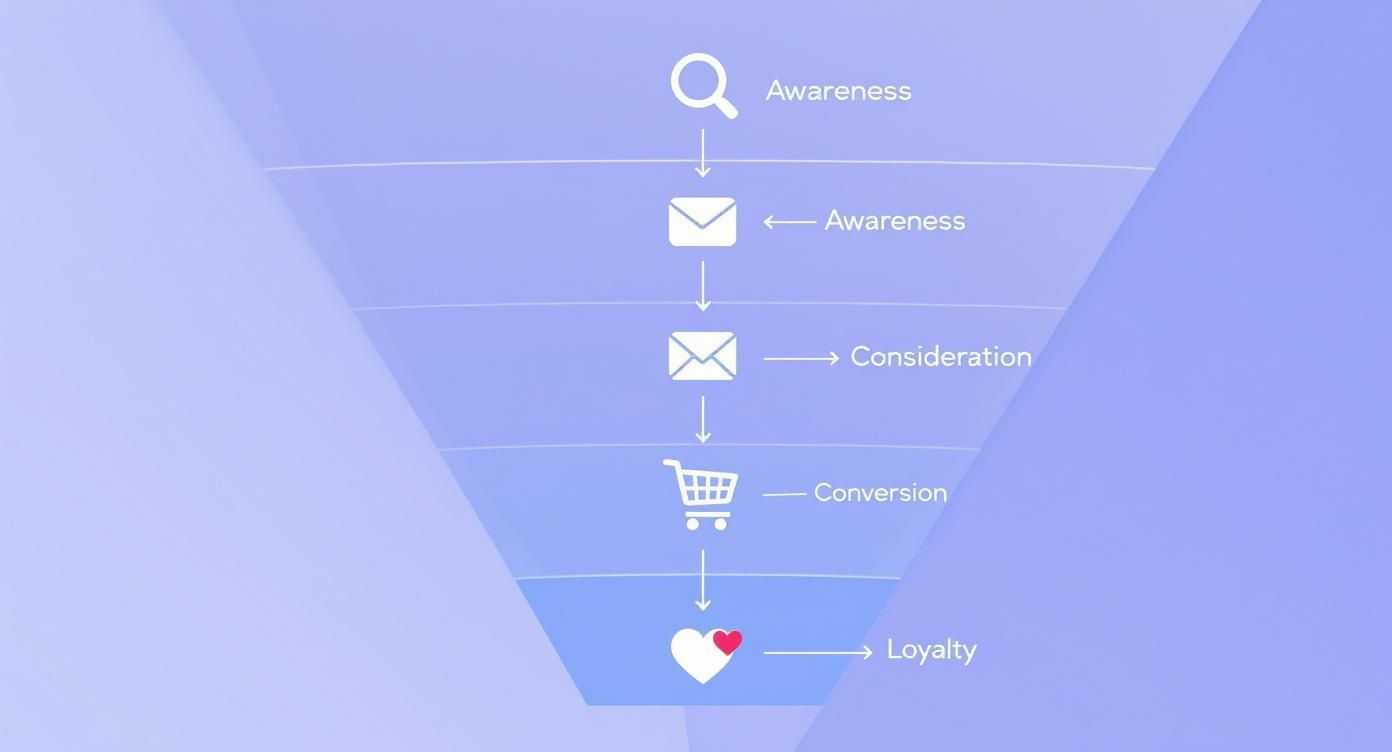
alt text: An infographic showing the marketing funnel (Awareness, Consideration, Conversion, Loyalty) with specific AI applications listed for each stage, such as “AI-driven SEO” for Awareness and “Predictive Analytics” for Loyalty.
Personalizing Campaigns at Scale with AI
Personalization is where AI transforms marketing from mass communication into a series of one-to-one conversations. This is how you connect with customers on a deeper level and drive action.
A staggering 80% of companies globally already use AI in their marketing measurement, a figure that rises to 85% in North America and Latin America. This shows that data-driven personalization is no longer optional—it’s the standard.

alt text: An AI advertising dashboard displaying multiple personalized ad creatives for different audience segments, with performance metrics like click-through rate and conversion rate for each variation.
Predictive Segmentation for Smarter Targeting
Traditional segmentation is reactive, grouping audiences based on past actions. AI-powered predictive analytics is proactive, segmenting users based on what they are likely to do next.
Tools like Lytics or Ortto analyze thousands of behavioral data points to build predictive models. These models can identify customers at risk of churning, those ready to upgrade, or prospects on the verge of making a purchase. This allows you to engage them with the right message at the perfect moment. Understanding content personalization is the strategic foundation for these AI-powered tactics.
Practical Example: Setting Up a Predictive Ad Campaign
Let’s say you’re an e-commerce brand running a paid social campaign. Here’s how you can use AI to automate creative generation and optimization with a tool like AdCreative.ai.
- Step 1: Upload Brand Assets: Provide the AI with your logos, brand colors, product images, and key value propositions.
- Step 2: Define the Campaign Goal: Set your objective (e.g., “drive sales for our new summer collection”) and specify the target audience (e.g., “women ages 25-40 interested in sustainable fashion”).
- Step 3: Generate and Test: The AI generates hundreds of ad variations, mixing and matching headlines, images, and calls to action. It then automatically launches A/B tests across your ad channels (e.g., Facebook, Instagram).
- Step 4: Automate Optimization: The platform continuously monitors performance. It automatically reallocates your budget to the winning ad variations and pauses the underperformers, maximizing your return on ad spend (ROAS) without manual intervention.
This creates a powerful feedback loop where real-time data drives your creative strategy, ensuring your campaigns remain fresh and effective.
Actionable Takeaways
- Audit Your Data: Identify what first-party data (e.g., website behavior, app usage) you’re collecting that an AI could use for predictive modeling.
- Start with One Segment: Choose a single high-value predictive segment, like “likely to churn” or “ready to buy,” and build a simple automated workflow around it.
- Run a Creative Test: Use a tool like AdCreative.ai to generate 10-20 ad variations for your next campaign. Test them against your manually created ads to measure the performance lift.
- Map Key Moments: Identify two or three points in your customer journey where a predictive, personalized message could have the biggest impact.
Your Action Plan for Responsible AI Implementation
Using AI in marketing comes with the responsibility to be ethical and transparent. Building trust with your customers is paramount.
- Establish a Baseline: Before implementing a new AI tool, document your current KPIs (CAC, CLV, conversion rates). This is your “before” picture to measure against.
- Draft a Simple AI Ethics Charter: Create a one-page document outlining your principles for data privacy, transparency, and human oversight. A key rule should be that a human always has the final say on customer-facing AI outputs.
- Appoint a Human Checkpoint: For every automated workflow, assign a team member to be the final reviewer before it goes live. This prevents errors and ensures brand consistency.
- Start Small, Prove Big: Pick one AI-powered campaign. Track its performance against your baseline metrics for 30 days. Use these results to build a case for wider adoption.
To dig deeper into this topic, explore our guide on applying ethical AI in daily decisions.
Your AI Implementation Checklist
This is your game plan for integrating AI into your marketing workflow, starting today.
Phase 1: Laying the Groundwork and Scoring Quick Wins
Focus on one or two high-impact areas to build momentum and get buy-in from your team.
- Identify Your Biggest Bottleneck: Pinpoint the single task that consumes the most time or resources. Start there.
- Select a Single-Purpose Tool: Choose an AI tool designed to solve that specific problem. For great options, check out this guide on the best AI tools for small business.
- Establish a Baseline Metric: Before you start, document a relevant KPI (e.g., “hours spent per blog post,” “cost per lead”). You’ll need this to prove ROI.
Phase 2: Scaling Up and Setting the Rules
With a proven win, you can expand AI into other parts of your strategy while establishing guardrails.
Your job won’t be taken by AI. It will be taken by a person who knows how to use AI. The same is true for businesses—those that master these tools will outpace those that don’t.
- Expand to Another Funnel Stage: If your first success was with top-of-funnel content, now look at a middle-funnel opportunity like AI-powered lead nurturing.
- Develop an AI Usage Policy: Create a simple document outlining your rules for data privacy, transparency, and mandatory human review for all AI-generated content.
- Train Your Team: Host a workshop on prompt engineering best practices. The better their prompts, the better the AI’s output will be.
Actionable Takeaways & Next Steps
- Pick One Task: Identify one repetitive marketing task you do every week and find an AI tool that can automate 80% of it.
- Write Your First Power Prompt: Use the template in this article to craft a detailed prompt for a real-world task you need to complete.
- Map a Core Workflow: Whiteboard a key process, like content creation from idea to publication, and circle every manual touchpoint that AI could streamline.
- Schedule a 30-Day Check-In: Put a meeting on your calendar one month from now to review your baseline metric and measure the impact of your first AI implementation.
Tools & Resources
- Prompt Engineering Guides: Check out prompt marketplaces like PromptBase for inspiration on crafting effective instructions for AI models.
- Core AI Models: Experiment directly with the leading large language models to understand their capabilities:
- OpenAI’s GPT-4
- Anthropic’s Claude
- Further Reading:
Your Top AI Marketing Questions, Answered
Let’s address the most common questions marketers have when getting started with AI.
Do I Need a Massive Budget to Get Started With AI?
No. Many of the most powerful and effective AI marketing tools are surprisingly affordable. You can start experimenting with leading models like ChatGPT or Claude for as little as $20 per month. Many tools offer tiered subscriptions or pay-as-you-go plans, allowing you to start small, prove the value, and scale your investment as you see a clear return.
What Kind of Skills Does My Team Actually Need?
You don’t need to hire data scientists or engineers. The most critical skills are already in your marketing department: strategic thinking and a deep understanding of your customer. Your team should focus on developing three key competencies:
- Strategic Direction: Knowing what business problem you’re trying to solve with AI before you choose a tool.
- Prompt Engineering: Learning to write clear, specific, and context-rich instructions to guide the AI toward the desired output.
- Critical Review: Having a sharp editorial eye to fact-check, refine, and add unique human insight to all AI-generated content.
How Do I Keep AI-Generated Content From Sounding Robotic?
The secret is to maintain a human-in-the-loop workflow. AI should never have the final word on customer-facing content.
Use the 80/20 Rule:
- 80% AI: Let the AI handle the heavy lifting—the initial research, outlining, and first draft.
- 20% Human: Your team provides the final 20%—the critical layer of nuance, storytelling, brand voice, and fact-checking that makes the content authentic and trustworthy.
This partnership ensures you gain efficiency without sacrificing the quality and personality that define your brand.
Ready to find the right AI tool for your marketing needs? Explore the AI Tools Hub, where you can search and compare over 11,000 tools across 2,000 categories to build your perfect marketing stack. Visit us at AI Tools Hub.
One Reply to “How to Use AI for Marketing to Drive Real Growth”
This is such a practical take on AI marketing. I love the point about starting small and finding quick wins instead of trying to overhaul everything at once. The idea of AI giving your team superpowers rather than replacing them really resonates — it’s all about automating the boring stuff so people can focus on strategy and creativity. I’ve seen similar benefits with AI tools for other creative tasks, like using AI to preview hair color changes before committing. Great framework! Change Hair Color Online.